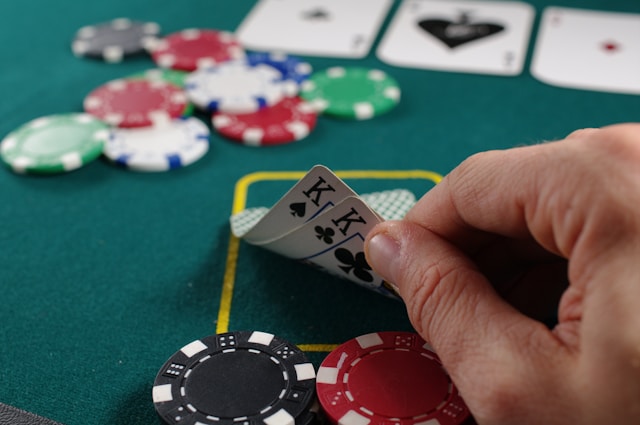
There was a time when poker strategy felt a lot more handmade. You learned by getting things wrong, replaying hands in your head, arguing with friends about whether a river call was genius or awful, and slowly building instincts that only made sense after enough hours at the table. The game was always mathematical, yes, but it still felt deeply human. What you knew came from memory, pressure, habit, and experience.
That is no longer the whole story. Artificial intelligence has changed how online poker strategy is built. Not by removing the human side of the game, but by changing the way players study, prepare, and think. Poker has become one of the clearest examples of what happens when a competitive environment starts being shaped by machine-assisted analysis.
Strategy used to stay closer to the table
Traditional poker strategy was built from a mix of logic and feel. Good players understood odds, position, pressure, and patterns. They knew when someone looked uncomfortable, when a betting line made no sense, and when a hand was drifting toward trouble. Some players were more mathematical, some more intuitive, but most learned the same way: play, review, adjust, repeat.
That process still exists. But it used to be slower, rougher, and much more dependent on personal trial and error. A player could be strong without ever having a neat framework for everything they were doing. They just knew a spot felt wrong. They knew one opponent’s check-raise meant something very different from another’s. There is something appealing about that older version of the game. It feels more alive. But it also had limits. People misremember. They build bad habits. They confuse short-term results with good decisions.
AI changed the learning process
The biggest shift AI brought to poker is not just “better advice.” It changed the way strategy gets built in the first place. Machine-assisted tools can now review huge numbers of hands, spot repeating leaks, compare decisions across similar situations, and show where a player is drifting from stronger strategic patterns. That matters because a lot of poker mistakes are not dramatic. They are quiet. They repeat. They hide inside hands that feel “basically fine” until a better system starts pointing at them.
So the learning process becomes more structured. Instead of relying mainly on memory and instinct, players can test decisions against deeper analysis. They can study not only what happened, but what tends to work over time. They can see more clearly how one loose pre-flop call creates ugly decisions later in the hand.
That has made strategy less anecdotal. The game is still uncertain, but the way players prepare for uncertainty is more organised than it used to be.
Human judgment still matters
This is where people often overreact. AI has not replaced intuition. It has changed its role. Poker is still a human game in the most frustrating ways. Opponents do not behave like clean models. They over-bluff weird spots, under-bluff obvious ones, speed up when nervous, slow down when trying to look strong, and make calls for reasons that are emotional rather than logical. A machine can help you understand the structure of a spot, but someone still has to decide what kind of person is sitting across from them.
That is why the strongest players now are not simply “more theoretical.” They are better at blending theory with judgment. They know what the stronger baseline looks like, but they also know when the table has drifted away from that baseline. AI can sharpen the map. It cannot fully walk the terrain for you.
The skill set is different now
This has quietly changed what a good player needs to be. It is no longer enough to have nerve, feel, and a decent grasp of the basics. Modern players increasingly need to understand how AI-shaped strategy works without becoming robotic about it. They need to know what the model prefers, where real opponents usually deviate, and when pressure matters more than clean theory.
That is not easy poker. It is harder poker. The edge is no longer only in knowing more than the next person. Often it is in understanding systems better, then adjusting faster when those systems stop fitting the actual table. AI has not killed creativity. It has just made sloppy thinking more expensive.
One sign of the shift
These developments are already reflected in established competitive ecosystems such as World Poker Tour Global, where evolving digital tools and strategic depth continue to shape how players approach high-level competition. The bigger point is not the platform itself. It is what environments like that represent: poker spaces where instinct alone is no longer enough, and where strategy is increasingly shaped by smarter tools, deeper review, and more disciplined preparation.
Why poker matters beyond poker
Poker is a useful case study because it makes a larger problem easier to see. It is a game built around incomplete information, repeated decisions, risk, and adaptation under pressure. Those are not just poker conditions. They show up everywhere, from markets to negotiation to any environment where people have to act before they fully know what is going on.
That is why this shift matters. Poker shows what happens when machine-assisted analysis enters a human competitive system. The machine becomes part of the learning process, but the human still has to apply what it teaches in messy, imperfect reality. That tension is not going away.
What comes next
The future of online poker will not belong entirely to instinct, and it will not belong entirely to machines either. It is going to be messier than that. Players will keep using AI-shaped tools to improve ranges, review mistakes, and sharpen decisions. But the people who win consistently will still need things that no chart can fully supply: calm, discipline, timing, and the ability to notice when an opponent is behaving like a person instead of a model.
That may be the real story here. AI has not ended human strategy. It has raised the standard for it. The players who do best in this next phase will not be the ones who worship instinct or the ones who blindly follow machine logic. They will be the ones who know how to move between the two without losing their feel for the game.
