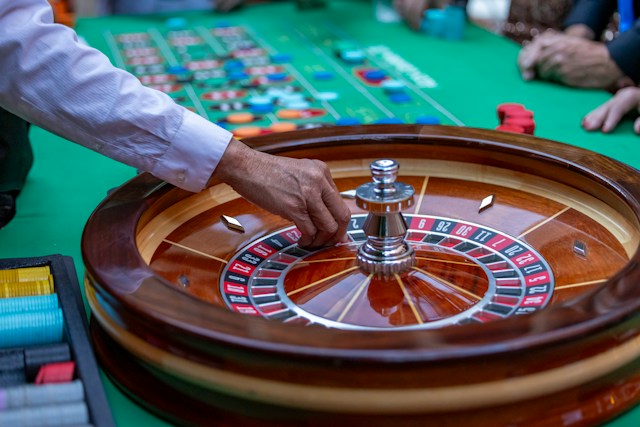
A buddy showed me his phone at a bar last month, and I was expecting a slot game with a dragon on it. It was roulette. Plain green felt, the wheel in the top third of the screen, a dealer in a studio somewhere saying good evening to the chat. He’s 34, he owns every console since the GameCube, and the thing he plays on his phone is a game they were already playing in Paris in the 1790s. He is not unusual. The industry keeps shipping slots by the thousand, and the games people keep coming back to are the three you already know: roulette, blackjack and baccarat.
The rules fit in a text message
Roulette: put chips on the felt, the ball picks a pocket, the felt says what you get. Blackjack: beat the dealer’s hand without going past 21. Baccarat, in the version you’ll find in a casino or an app, doesn’t even ask you to make a decision after the bet. My buddy’s dragon slot, by contrast, has six bonus modes and a cascading reel mechanic, and the first time you hit one you’re reading a help screen.
A learning curve is a reason to close an app. The classics have none, because they were built for a crowded room where a stranger could follow along after one hand, and that turns out to be a good spec for something you open with one thumb while the coffee brews.
The odds are public knowledge too, which slots can’t say in the same way. Britannica has the numbers: a double-zero American wheel gives the house about 5.26 percent, a single-zero European wheel about 2.7, and with the “en prison” rule on even-money bets it drops to about 1.35. A slot publishes a return figure in its help menu, but that figure covers the whole game rather than a bet you get to pick.
The upgrade you don’t see
I didn’t notice how much engineering goes into a roulette game online until my buddy handed me the phone, which I suppose is the idea. The grid got redrawn for a thumb, so the chip lands where you tapped and you’re not pinching to zoom to find red. There’s a close-up camera on the drop. And the number gets read by sensors in the rim of the wheel, so it posts when the ball settles instead of when somebody types it in.
Blackjack got the same treatment: cards on camera, your hand total on the screen, a dealer who greets you by name. They sell it as “authentic.” It’s television. Somebody worked out that a dealer at a table is a broadcast, and the audience for that format was already sitting there.
You get to drive
The other thing the classics have over slots is that you’re doing something. A slot spin is a button and a wait. A blackjack hand is a sequence of decisions, and the decisions are worth money. Robert Hannum’s Casino Math, published by UNLV’s gaming research center, puts the house edge in a six-deck game at about 0.5 percent for a player who follows basic strategy, and a lot higher for one who plays on feel. The counting story in 21, the one about the MIT team, is a movie because those decisions matter, and it’s why blackjack players carry a chart.
Roulette gives you a different kind of control: the pace. There’s a spin, there’s a wait, and the wait is where you decide how much you’re in for on the next one. Slot designers spent a decade shortening the gap between spins, and regulators in Britain and Germany have since put a floor under it, 2.5 seconds and five seconds a spin. The table games never needed the rule, because the dealer sets the pace.
Old game, new toys
The developers didn’t leave the classics alone, though. The trend of the last few years is a standard wheel with something bolted on: a random handful of numbers that pay out at a multiplier if the ball lands on them, a second ball, an automated wheel with no dealer at all. The trade-off is usually a trimmed base payout on straight-up bets to fund the multipliers, which is the math balancing itself, and the plain game is still there for anyone who wants it.
The category has split along that line.
The traditionalists get the felt, the single zero and a dealer who takes her time. The players who grew up on video games get the same wheel with a bonus round attached, and both versions sit on the same screen. My buddy plays the plain one. He says the multiplier version feels like it’s trying too hard. I watched him lose eleven dollars over about forty minutes while the dealer wished a man in Michigan a happy birthday, and he did not once look at the time.