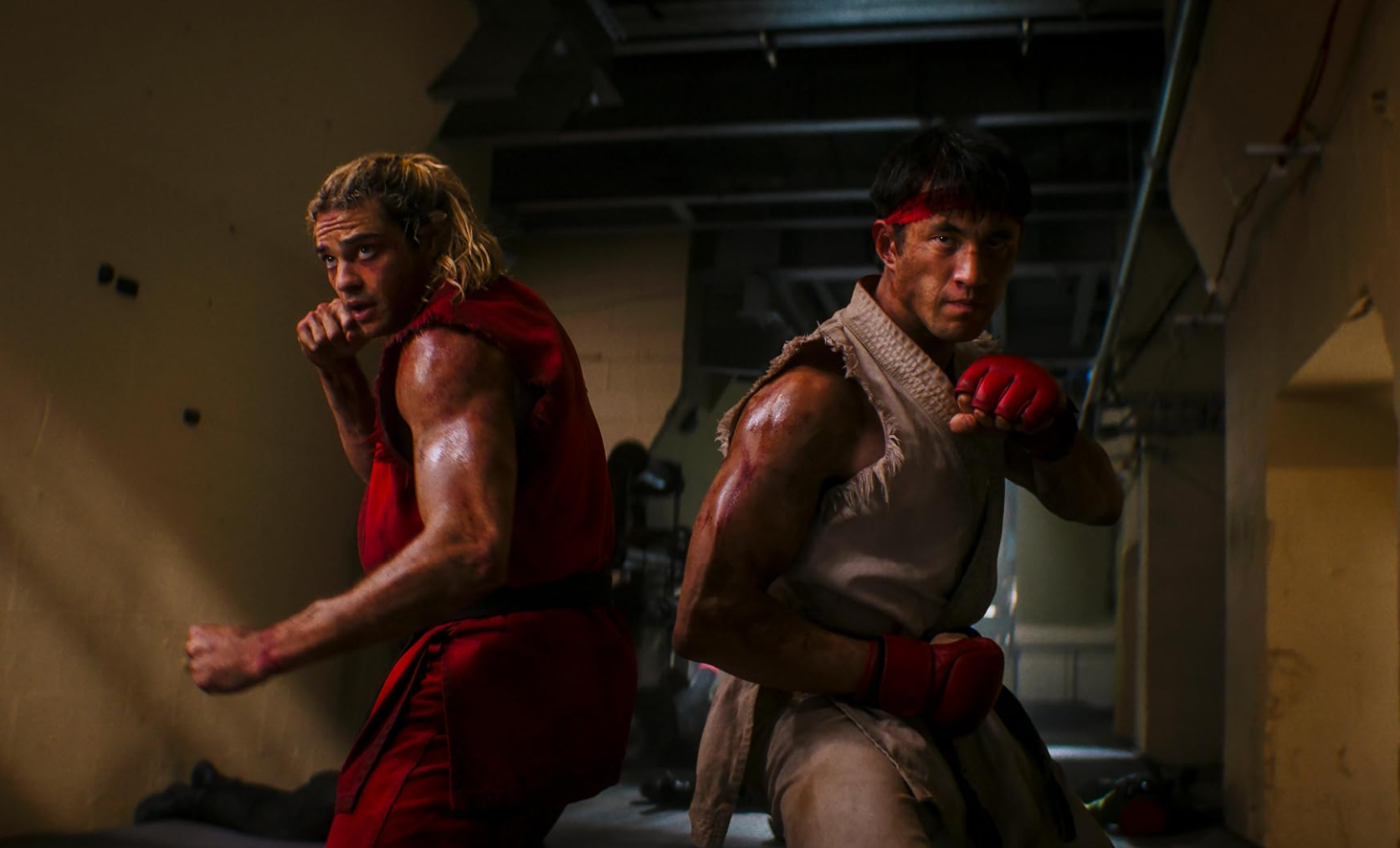
It’s almost impressive when a film like “Street Fighter” fails so blatantly across multiple genres. It’s not just that the new adaptation of the video game is a terrible action movie, but Kitao Sakurai’s endeavor is also awful at its attempts at comedy as well. It’s legitimately maddening that it’s so hard for so many to turn the fighting game into an entertaining cinematic experience. It’s a fighting tournament! The template for these types of movies was cemented in 1973’s “Enter the Dragon,” done again in “Bloodsport,” and countless other titles since to varying degrees of success. And yet, instead of a fun action movie with some quips or winks to the game, we received this limp attempt at action-comedy that doesn’t work on any level and leaves audiences exhausted, bored, and annoyed.
In 1987, Ryu (Andrew Koji) won the first World Warrior Tournament but does so by tapping into a darkness that awakens an ancient demon. Later, Ryu forsakes fighting all together, leaving his sparring partner and erstwhile brother Ken (Noah Centineo) to become a laughingstock who uses his fighting prowess for ridiculous stunts and promotional events, orchestrated by his friend and manager, Dan (Andrew Schulz). Flash forward to 1993 and M. Bison (David Dastmalchian) is launching the World Warrior Tournament again, but for his own nefarious purposes. Ken is oblivious to these ulterior motives when he is recruited by Chun-Li (Callina Liang) on behalf of Bison, which also draws Ryu out of exile to protect Ken from the darkness at the heart of the tournament.
There’s so much more plot and characters, and you know what? None of it matters. For those interested, though, here’s who shows up from the game (beyond those mentioned already): Akuma (Joe Anoa’i – aka Roman Reigns), Guile (Cody Rhodes), Blanka (Jason Momoa), Don Sauvage (Eric André), Balrog (50 Cent), Gouken (Ma Dong-seok aka Don Lee), Cammy (Mel Jarnson), Vega (Orvilla Peck), E. Honda (Hirooki Goto), Dhalsim (Vidyut Jammwal), Zangief (Olivier Richters), and Juli (Rayna Valandingham). Technically there are a couple more characters from the game in there too, and it should be fun to hear Striker mentioned or see a Hadouken in live action, but it’s all just an interminable, sloppy, slog. In theory, these are talented performers who at least know how to look good fake fighting. Yet it’s all shot and edited in such a horribly boring way that it never entertains. It’s not grounded enough to be viscerally engaging but it also doesn’t commit to the silliness of the heightened reality to be classified as campy fun.
Here’s an example that sounds like a nitpick: sometimes when people are kicked into concrete walls, it really hurts them; other times, it barely slows them down at all. Sakurai doesn’t commit to either version of the reality he wishes to create and instead lands on this muddled liminal space where no one is satisfied and everything hurts. This is made so much worse by the constant attempts at comedy that feel like the writers (Sakurai and T.J. Fixman, from a story by Dalan Musson and Gary Dauberman) learned every wrong lesson from James Gunn’s blockbusters in recent years. “Random” jokes and gay panic lines are bandied about but never fully land, in between the constant winking of how goofy everything is. “Street Fighter” knows it’s wacky, so doesn’t that make it cool? No, no it does not. (I did chuckle one (1) time — when Ryu is offered a Shirley Temple to drink and Koji says, incredibly stoically, “I do like those.” That’s it.) The attempts at comedy are non-stop and awful.
For a fighting tournament movie, “Street Fighter” also has very little fighting tournament in it. Oh there’s action scenes—many incompetently choreographed and painfully listless fight scenes—but most exist outside of the tournament, and in fact a bunch of the fights are either forfeited before they begin or happen offscreen. Guile and Vega fight at one point…but we don’t see any of it, just the aftermath (and another dull, winking quip) and then Vega forfeits his next round. What? Why? Again, there’s a ready-made formula for these types of movies that, when adhered to, has worked for over 50 years, and yet the filmmakers assume they know better and avoid anything resembling dramatic structure or real character arcs. “Street Fighter” fails to engage in such a major way, that I kept being distracted by the anachronistic soundtrack—it starts in 1987, where Ryu is listening to “What’s Up” by 4 Non Blondes (which came out in 1992) and then, after the six-year flash forward to 1993, the film uses (terrible remixes of) songs from 1994 and 1995. It’s a stupid nitpick that wouldn’t matter or could be easily forgiven of a competently-made movie, and yet I was so divorced from the proceedings on the screen that I bristled at every needledrop. That’s how much Sakurai and company lost me with their meandering script and uninteresting action sequences.
“Street Fighter” is terrible, but not without its merits—few movies are wholly rotten, after all. Andrew Koji and Callina Liang play their characters well and, in a better film, would be perfectly cast. Here their welcomed energy and engagement is utterly wasted. There are cool animated sequences that are probably the best part of “Street Fighter”—until they are re-used too much and become dull through repetition. Everything with “Street Fighter” is one step forward, two steps back, and it results in one of the worst films of the year (particularly for its budget and pedigree). I wasn’t expecting a profound experience (though there’s no reason why it couldn’t be one in better hands), but it shouldn’t feel so interminable and uninspired. With “Street Fighter,” everything feels forced, nothing feels genuine, and the whole movie is a fight to get through.
1.5 / 5 Stars
Directed by: Kitao Sakurai
Starring: Andrew Koji, Noah Centineo, Callina Liang, David Dastmalchian, Andrew Schulz, Joe Anoa’i, Cody Rhodes, Jason Momoa, Eric André, 50 Cent, Ma Dong-seok, Mel Jarnson, Orvilla Peck, Hirooki Goto, Vidyut Jammwal, Olivier Richters, Rayna Valandingham
