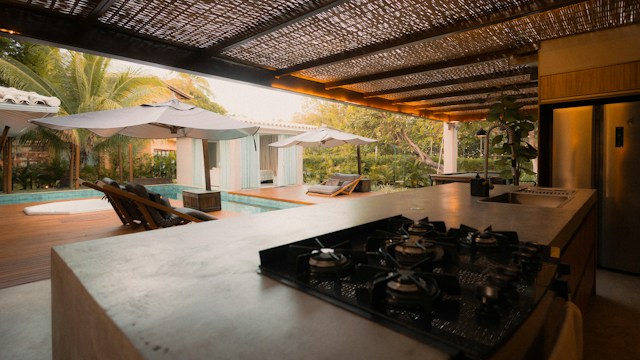
Every guy who has ever planned an outdoor kitchen hits the same moment. The layout is sketched, the countertop is picked out, and then the real question lands: what are you actually going to cook on? A freestanding grill is easy to swap when you change your mind. A built-in is not. Once it is cut into stone and plumbed for gas, you are living with that decision for the next fifteen years.
The good news is that there is no single right answer. The best setup is the one built around how you actually cook, not around the biggest number on a spec sheet. Here is how to think it through before anything gets cut.
Start With How You Cook, Not What Looks Good
Be honest about your habits. The guy who grills chicken thighs on a Tuesday night needs something very different from the guy who smokes a brisket every other Saturday.
| If you mostly… | Build around… |
|---|---|
| Cook fast weeknight dinners | A gas grill, ideally with a sear zone |
| Host big groups on weekends | A wide gas grill plus a side burner or griddle |
| Chase smoke flavor and low-and-slow cooks | A built-in pellet grill or a kamado |
| Love the ritual of live fire | A charcoal grill or kamado |
| Want a project for every season | A gas grill as the anchor, plus one specialty cooker such as a pizza oven or smoker |
Most well-designed outdoor kitchens end up with a primary cooker for everyday use and, if space and budget allow, one specialty piece for the cooking you do for fun.
The Gas Grill: The Everyday Workhorse
For most people, a built-in gas grill is the backbone of the kitchen. It lights instantly, holds steady heat and makes a Tuesday night cookout realistic. A few features are worth paying attention to:
- Natural gas or propane. A natural gas line means you never run out mid-cook, but it has to be planned and run to the island. Propane is simpler to start with but means swapping tanks. Grills are generally built for one fuel or the other, so decide before you buy.
- A sear zone. An infrared or high-output sear burner gets a proper crust on a steak in a way standard burners struggle to match.
- A rotisserie burner. A rear rotisserie burner turns a whole chicken or a prime rib into an easy showpiece.
- Don’t chase BTUs. A huge total heat number means little on its own. Build quality, burner design and how evenly the grill holds heat matter far more.
Charcoal and Kamado: For the Live-Fire Crowd
If you care more about flavor and the ritual of building a fire, charcoal belongs in the conversation. Built-in charcoal grills offer the classic experience in a permanent setup. Kamado-style ceramic cookers hold heat remarkably well, which makes them versatile enough to sear at high heat or smoke low and slow for hours.
The trade-off is time. Charcoal takes longer to get going and more attention to manage. That is exactly the point for some guys and a dealbreaker for others. Kamados also need a properly sized cutout or a dedicated cart-style space in the island, so plan for them early rather than trying to squeeze one in later.
Built-In Pellet Grills: Set It and Smoke It
Pellet grills feed wood pellets into a firepot automatically and use a controller to hold a set temperature. For anyone who wants real smoke flavor without babysitting a fire all day, they are hard to beat. The catch for a built-in is power. Pellet grills need electricity, and outdoor cooking appliances with electrical components often call for a dedicated GFCI-protected circuit, so the electrical has to be part of the plan from day one.
Pizza Ovens and Specialty Cookers
A built-in pizza oven is the specialty piece most people end up loving. Wood-fired ovens deliver the classic flavor and experience; gas-fired ovens heat faster and are easier to control. Griddles have also become hugely popular for breakfast, smash burgers and anything that would fall through grill grates. Choose the one you will actually use most, rather than trying to fit everything.
Material Matters More Than Most People Realize
“Stainless steel” is not one thing. Higher-end built-in grills typically use 304 stainless, which contains nickel and resists rust and corrosion far better outdoors. Many budget models use cheaper 430 stainless, which is more prone to rusting when left outside. A quick trick: 430 is magnetic and 304 generally is not, so a magnet in your pocket at the showroom tells you a lot. Pay attention to the firebox, burners and hood, not just the visible panels.
The Build Details That Keep You Safe
A built-in cooker is a gas appliance set into a structure, and the installation matters as much as the grill itself.
- Insulated jackets. If the island is built with combustible materials, such as a wood frame, many grills must be installed in an insulated jacket that meets the manufacturer’s clearance requirements. Islands built from concrete block, stone or metal studs often do not need one.
- Island ventilation. Gas islands need vents so leaked gas cannot collect inside the cabinet. Some manufacturers specify at least two vents of a minimum size in the island.
- Overhead covers. Putting a grill under a pergola, patio roof or covered structure changes the rules. Manufacturer instructions commonly require an exhaust hood over the grill when it sits under combustible overhead construction.
- Read the manual before you design. Every grill has its own cutout dimensions and clearance requirements. Design the island around the appliance, not the other way around.
Local Rules Can Shape Your Choices: A Bay Area Example
Where you live can influence what makes sense, especially when it comes to fire features. In the San Francisco Bay Area, the regional air district issues winter Spare the Air alerts that make it illegal to burn wood in outdoor fire pits and other wood-burning devices on alert days. Cooking is treated differently: fires for cooking, including grills and smokers, have been allowed, and natural gas and propane fireplaces are permitted during alerts.
That is one reason many Bay Area homeowners pair a gas fire feature with their outdoor kitchen instead of a wood-burning fire pit, so the space stays usable all winter. A Bay Area outdoor kitchen builder who knows those rules can help match the cooking setup and fire features to how the space will actually be used year-round. Wherever you live, it is worth checking local air quality, fire and building rules before you commit to a wood-burning feature.
A Quick Planning Checklist
| Decision | What to settle before construction |
|---|---|
| Primary cooker | Gas, charcoal, kamado or pellet, based on how you cook most |
| Fuel | Natural gas line or propane, and where it will run |
| Specialty piece | Pizza oven, griddle, smoker or side burner, if any |
| Electrical | Power for pellet grills, lights, rotisseries and refrigeration |
| Island construction | Combustible or non-combustible, and whether jackets are needed |
| Ventilation | Island vents and an overhead hood if the grill sits under a cover |
| Local rules | Permits, plus any restrictions on wood-burning features |
The Bottom Line
The best outdoor kitchen is the one you actually cook in. Build around how you like to cook, buy quality where it counts, and get the gas, electrical and ventilation right before the stone goes on. Do that, and you will be firing it up on a random Tuesday as often as you do on game day.
