Standing in the Theater of Epidaurus, a person whispering at the center of the stage can be heard clearly by someone sitting in the last row, 55 rows up and nearly 60 meters away. No microphones, no speakers, just limestone cut with mathematical precision more than 2,300 years ago. That’s the kind of thing that makes ancient history stop being a textbook chapter and start being something you can stand inside. Greece is full of places like this, where the past isn’t behind glass but underfoot.
The Acropolis of Athens
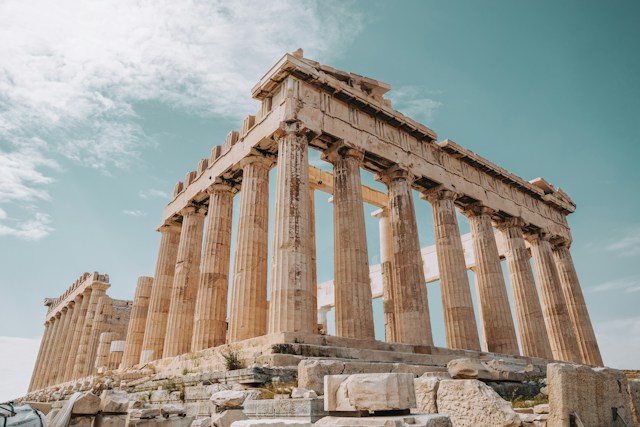
The Parthenon still dominates the Athens skyline the way it dominated the ancient city, and walking up the marble path to reach it gives a real sense of how deliberately the Athenians built for impact. The Erechtheion, with its six carved maiden columns, sits just north of the main temple and tells its own story about religious rivalry between Athena and Poseidon. The nearby Acropolis Museum displays original friezes and statues at eye level, which makes it far easier to grasp the scale of the craftsmanship than squinting up at the building itself.
Delphi
Ancient Greeks believed Delphi was the center of the world, and the ruins still convey why. The Sanctuary of Apollo housed the Oracle, whose cryptic prophecies shaped decisions made by kings and generals across the Mediterranean. The site’s museum holds the Charioteer of Delphi, a bronze statue so lifelike that its glass eyes still unsettle visitors who get close.
Knossos, Crete
Knossos is where the Minoan civilization built a palace complex so sprawling and maze-like that it likely inspired the myth of the Labyrinth. Excavated by Sir Arthur Evans in the early 1900s, the site includes reconstructed frescoes showing dolphins, bull-leapers, and processions in colors bright enough to feel almost modern. It predates classical Athens by more than a thousand years, which helps put the usual “ancient Greece” timeline into better perspective.
Mycenae
Mycenae gives weight to stories usually treated as pure myth, including the House of Atreus and the legend of Agamemnon. The Lion Gate, a massive stone entrance topped by two carved lionesses, has guarded the citadel since around 1250 BCE. Beehive-shaped tombs called tholos tombs, including the so-called Treasury of Atreus, show engineering skill that wouldn’t be matched in the region for centuries.
Olympia
Olympia is where the Olympic Games began in 776 BCE, and the stadium track is still there for anyone who wants to stand where ancient runners lined up. The ruins of the Temple of Zeus once housed a 40-foot gold-and-ivory statue considered one of the Seven Wonders of the Ancient World. The on-site museum contains original discus and javelin equipment along with victory statues that put a human face on the ancient competitive spirit.
The Theater of Epidaurus
Built in the 4th century BCE, this theater remains one of the best-preserved examples of ancient acoustic engineering anywhere in the world. It’s still used for live performances today, which means visitors sometimes get to see it doing exactly what it was designed to do. Groups organizing school trips to Greece often build a stop here specifically so students can test the acoustics themselves, dropping a coin or reciting a line from center stage.
Thermopylae
The narrow pass at Thermopylae is where 300 Spartans and their allies held off a massive Persian army in 480 BCE, buying critical time for the rest of Greece to prepare. A modern monument marks the site, and the surrounding landscape makes it easy to understand why this particular strip of land mattered so much strategically. Standing there gives a clearer sense of scale than any map ever could.
Meteora
Meteora isn’t ancient Greek history in the classical sense, but the monasteries perched atop sheer rock pillars tell a different kind of historical story. Built starting in the 14th century by monks seeking isolation and protection, the six surviving monasteries required rope ladders and hauling nets just to reach. They reveal how geography shaped religious life in Greece long after the classical period ended.
Vergina
Vergina is home to the tomb of Philip II of Macedon, father of Alexander the Great, discovered largely intact in 1977. The underground museum built around the excavation displays gold larnakes, weapons, and armor exactly as they were found. It’s a rare case where the object and the discovery site haven’t been separated, which makes the connection to the actual burial feel immediate.
The Ancient Agora of Athens
While the Acropolis gets most of the attention, the Agora below it was the real center of daily Athenian life, where democracy, philosophy, and commerce all played out in the same open space. Socrates debated here, and the reconstructed Stoa of Attalos now houses artifacts including ancient voting tokens and ostraka, the shards used to cast votes for exile. It’s a useful reminder that ancient Greek history wasn’t only about temples and wars but about ordinary civic routine.
Visiting these sites works best when paired with even a little preparation beforehand, since knowing the basic story behind a ruin transforms it from a pile of stones into a specific event or decision that actually happened there. A guidebook chapter read the night before, or a quick summary of who built what and why, turns a walk through rubble into a walk through an argument, a battle, or a belief system that shaped everything that came after.