Every real estate agent and property developer knows that video content drives better results than static listings. Properties with video generate more inquiries, hold buyer attention longer, and communicate the feeling of a space in a way that photographs simply cannot. The problem is not awareness — it is execution. Professional property video production is expensive, logistically complex, and often produces content that is outdated before it reaches the right audience.
A development project that takes eighteen months to complete cannot rely on production-heavy video content created at the start of the sales cycle. The market shifts, the target buyer profile evolves, and the content needs to adapt — but traditional production does not accommodate that kind of flexibility.
Why Property Marketing Video Is Harder Than It Looks
Real estate and property marketing has specific visual demands that make it one of the more challenging categories for video content. Natural lighting changes the character of a space dramatically — the same room looks completely different at different times of day and in different seasons. Styling and staging communicate lifestyle aspiration that influences buyer perception as much as the physical specifications of a property.
For off-plan developments, the property does not yet exist in its final form, which means marketing teams need to communicate a vision rather than a reality. These are not problems that a standard video production approach solves well, and they are exactly the problems that AI video tools are increasingly capable of addressing.
Pollo AI’s AI Video Editor gives property marketers a practical solution to these challenges. Through text-based instructions, marketers can adjust the time of day shown in a property video — shifting from flat midday light to warm evening ambiance — change weather and atmospheric conditions, generate aerial or orbit camera perspectives that communicate spatial context without drone operators, and apply visual styles that align the property with specific buyer lifestyle aspirations.
For off-plan developments, AI video tools can transform architectural renders or early-stage photography into atmospheric marketing content that communicates the completed vision compellingly. These are capabilities that previously required significant post-production budgets and specialized technical skills.
The Property Marketer’s AI Video Toolkit
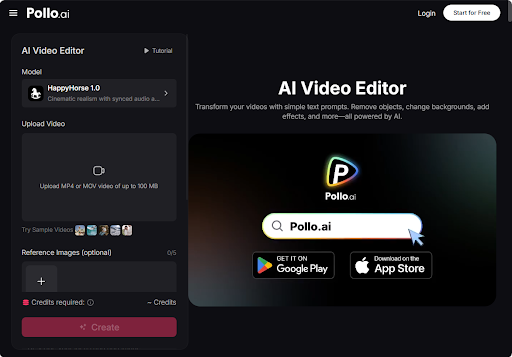
The most effective AI video strategy for real estate and property marketing combines product-specific video transformation with content marketing video production. On the product side, Pollo AI’s AI Video Editor handles the property-specific visual modifications — atmospheric adjustment, perspective generation, style application — that make individual property videos more compelling and more adaptable. On the content marketing side, a complementary tool handles the conversion of text-based content into video for broader distribution.
Lumen5 AI Video Generator is particularly well-suited to the content marketing dimension of property marketing. Real estate agencies and property developers typically produce significant amounts of text content — market reports, neighborhood guides, buyer advice articles, investment analysis — that has strong informational value but limited reach when published in text form alone.
Lumen5 can convert this content into professional video automatically, drawing from a large media library to match visuals to content, building scene structures intelligently, and producing output with AI narration available in over forty languages. For property brands operating in international markets or targeting overseas investors, the multilingual capability is a significant practical advantage.
Step-by-Step: Building a Property Video Marketing System
Step 1 — Audit Your Existing Visual Assets
Before investing in new content production, take stock of what you already have. Most real estate agencies and developers have a library of existing photography, architectural renders, and raw video footage that is underutilized. These assets are the raw material for AI video transformation — a strong source asset produces a stronger AI-generated output.
Step 2 — Define the Buyer Journey and Content Needs at Each Stage
Property marketing content serves different purposes at different stages of the buyer journey. Awareness-stage content needs to communicate lifestyle aspiration and location appeal. Consideration-stage content needs to communicate specific property features and value. Decision-stage content needs to build trust and address objections. Map your content needs to each stage before producing anything, so that every video asset you create serves a clear strategic purpose.
Step 3 — Apply AI Video Transformation to Key Property Assets
Using Pollo AI’s AI Video Editor, apply atmospheric and stylistic modifications to your key property videos and images. Generate time-of-day variations — morning light for properties with east-facing aspects, evening ambiance for west-facing terraces.
Apply lifestyle styling that aligns with your target buyer profile. Generate aerial perspectives that communicate the property’s relationship to its surroundings. Each variation extends the usefulness of your source asset without requiring additional production.
Step 4 — Convert Editorial Content Into Video With AI
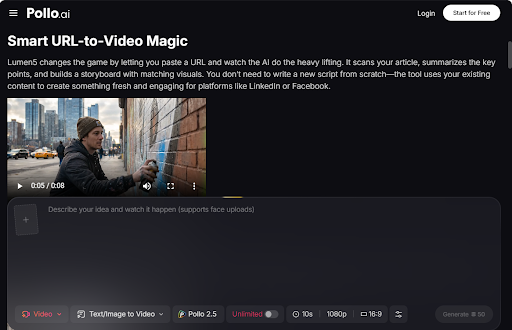
Take your existing text content — neighborhood guides, market reports, buyer advice articles — and use Lumen5 to convert it into video format for social media and YouTube distribution. This extends the reach of content you have already invested in producing, without requiring additional writing or research. The AI handles scene construction, media matching, and narration, producing professional output that maintains your brand’s visual identity through customized templates.
Step 5 — Distribute Strategically Across Channels
Property video content needs to be formatted and distributed differently across channels. Property listing platforms have specific technical requirements. YouTube favors longer, more detailed content that serves search intent. Instagram and TikTok reward short-form atmospheric content. LinkedIn is effective for reaching investor and commercial property audiences. Adapt your AI-generated content for each channel’s requirements rather than publishing a single version everywhere.
Advanced Applications for Property Developers and Agents
For off-plan developments, AI video transformation can convert architectural renders into atmospheric marketing content that communicates the completed vision — adjusting lighting, adding environmental context, and applying lifestyle styling that helps buyers imagine the finished space. This is particularly valuable during the pre-sales phase, when compelling marketing content is most needed but the physical property does not yet exist in its final form.
For property agents managing large portfolios, AI video tools make it practical to produce video content for every listing rather than only the highest-value properties. A consistent video presence across the full portfolio communicates professionalism and thoroughness that builds agency brand as well as individual property appeal.
For international property marketing, the combination of Pollo AI’s visual transformation capabilities and Lumen5’s multilingual narration support creates a practical workflow for producing localized marketing content without the cost of separate production runs for each target market.
Conclusion: Property Marketing Video Should Not Be a Luxury Reserved for Premium Listings
The real estate and property development sectors have long accepted that high-quality video marketing is something only premium listings can justify. AI video tools challenge that assumption directly. With the right workflow — AI video transformation for property-specific visual content, AI content conversion for editorial and market intelligence content — agencies and developers of any size can maintain a professional, comprehensive video presence across their full portfolio.
The properties that benefit most are not the ones at the top of the market. They are the ones in the middle, where a compelling video presence makes the difference between a listing that moves and one that sits.