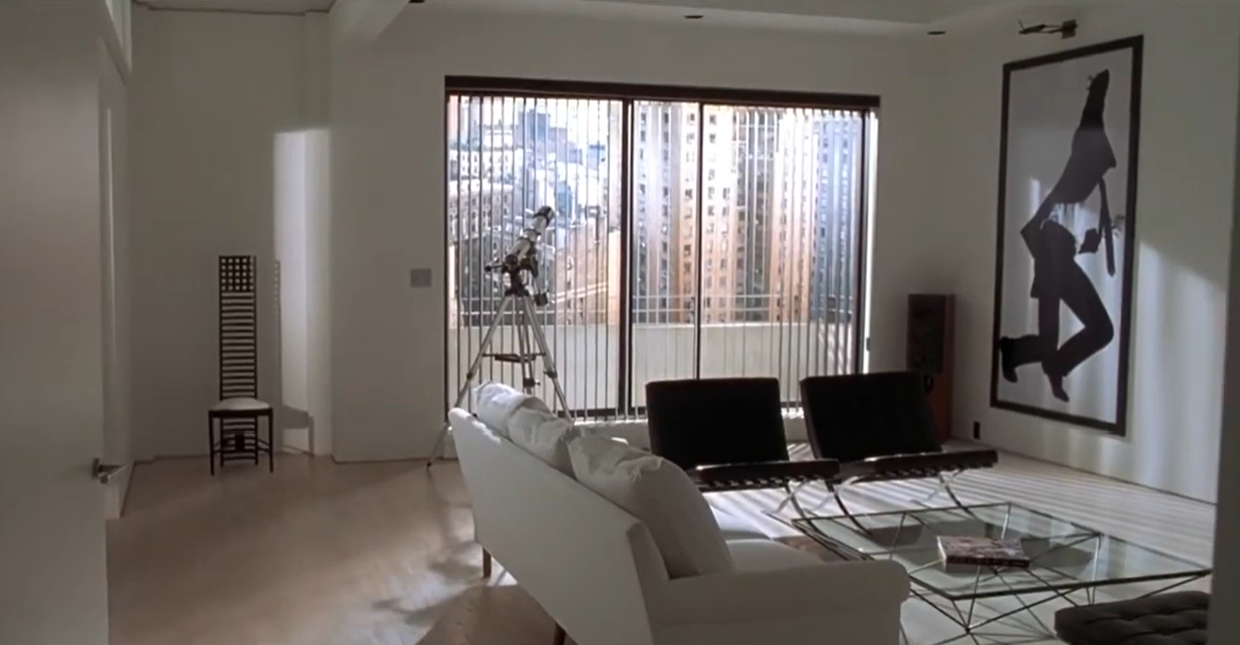
Patrick Bateman’s white-on-white Manhattan cube and Josh Baskin’s cavernous SoHo loft sold two versions of the same fantasy: that an apartment is a stage for the person you’d like to be, and that the right address alone does the work.
Watch either film in 2026 and the illusion cracks. The furniture reads as costume. The layouts don’t function, and the buildings behind them, if they existed at all, would fail a modern renter’s basic test for light, storage, and sound.
What follows walks the fantasy forward in time: how it was built on set, how it survived a couple of decades in the culture, where it started to break, and what a renter (or an owner) should reach for now instead.
The Set Was Designed to Intimidate, Not to House Anyone
For Bateman’s apartment, the design team chose furniture the way a curator chooses objects for a vitrine: a Mackintosh Hill House chair here, a Barcelona chair there, an Alanda coffee table anchoring the room. Every piece was a signal about the character, not a decision about how a person actually lives.
Big pulled the same trick from a different angle. Josh’s loft is empty because empty was funny, and enormous because enormous made the joke land. Nobody storyboarded where he’d keep a winter coat. The apartment worked as a punchline about arrested development, not as a floor plan.
Both spaces share a tell that’s easy to spot once you know to look for it: no clutter, no wear, no evidence that anything has ever been cooked, dried, charged, or put away. Real apartments carry friction, and a set is engineered to erase it.
For a While, the Fantasy Held Up
Through the 2000s and into the 2010s, the movie-loft aesthetic spilled into real listings. Developers marketed hard surfaces, open plans, and floor-to-ceiling glass. Renters signed up for it. Cold light, cool tones, and a skyline view read as adult and expensive, which was the whole point.
Then people moved in. The open plan meant every smell from the kitchen sat in the bedroom. The glass wall meant no wall to put a bookshelf against.
The polished concrete floor was a joy for about a week and a menace to every dropped glass after. The lifestyle-magazine apartment turned out to be a difficult apartment to actually live in.
What Actually Ages Well in an Apartment
Strip away the set dressing and a short list of qualities holds up across decades of design cycles. These are the things worth looking for on a tour, and worth investing in if you own the building.
- Natural materials with some grain. Wood that shows its age, stone with variation, wool and linen that soften with use. Designers who talk about longevity keep coming back to materiality because it forgives wear instead of recording it.
- Storage you don’t have to think about. A real coat closet near the door, a linen closet that isn’t a joke, kitchen cabinets that reach the ceiling. Storage is the amenity you notice every day.
- Light from more than one direction. Corner units, dual exposure, or at least windows tall enough to push daylight to the back wall. A room with one small window ages badly no matter what you put in it.
- Sound separation between rooms. Solid-core doors, insulated demising walls, a bedroom that doesn’t share a wall with the elevator. Quiet is the luxury that keeps paying you back.
- Systems that work without fuss. In-unit laundry that actually runs, HVAC you can zone, enough outlets in the right places. None of this photographs well. All of it decides whether you renew.
The Building Behind the Unit Does More Work Than the Décor
The other lie in those movies is that an apartment is a solo object. Bateman never deals with a leaking radiator upstairs. Josh never files a maintenance ticket.
In real life, the unit is only as good as the operation running the building around it. A gorgeous kitchen loses its charm the third time a repair request goes unanswered, and a plain-looking lobby wins you over the first time a package actually arrives where it’s supposed to.
That’s why the boring stuff, staffing, turn times, vendor lists, inspection cadence, separates a place that ages well from a place that just photographed well on move-in day. Owners who take professional apartment management seriously tend to keep their tenants longer than owners who treat the building like a brochure. Renters can feel the difference within a month, even if they can’t name it.
Watch the Movies, Rent the Opposite
American Psycho and Big are still fun. They’re not shopping guides. The apartments on screen were props built to serve a story, and the details that made them iconic (the empty rooms, the museum-grade chairs, the improvised trampoline in the middle of the floor) are exactly the details a real tenant would strip out by the second week.
What ages well is duller and better: light, storage, sound separation, materials that improve with use, and a building run by people who answer the phone. Sign a lease on those, and the apartment keeps working long after the aesthetic on the mood board has moved on.
