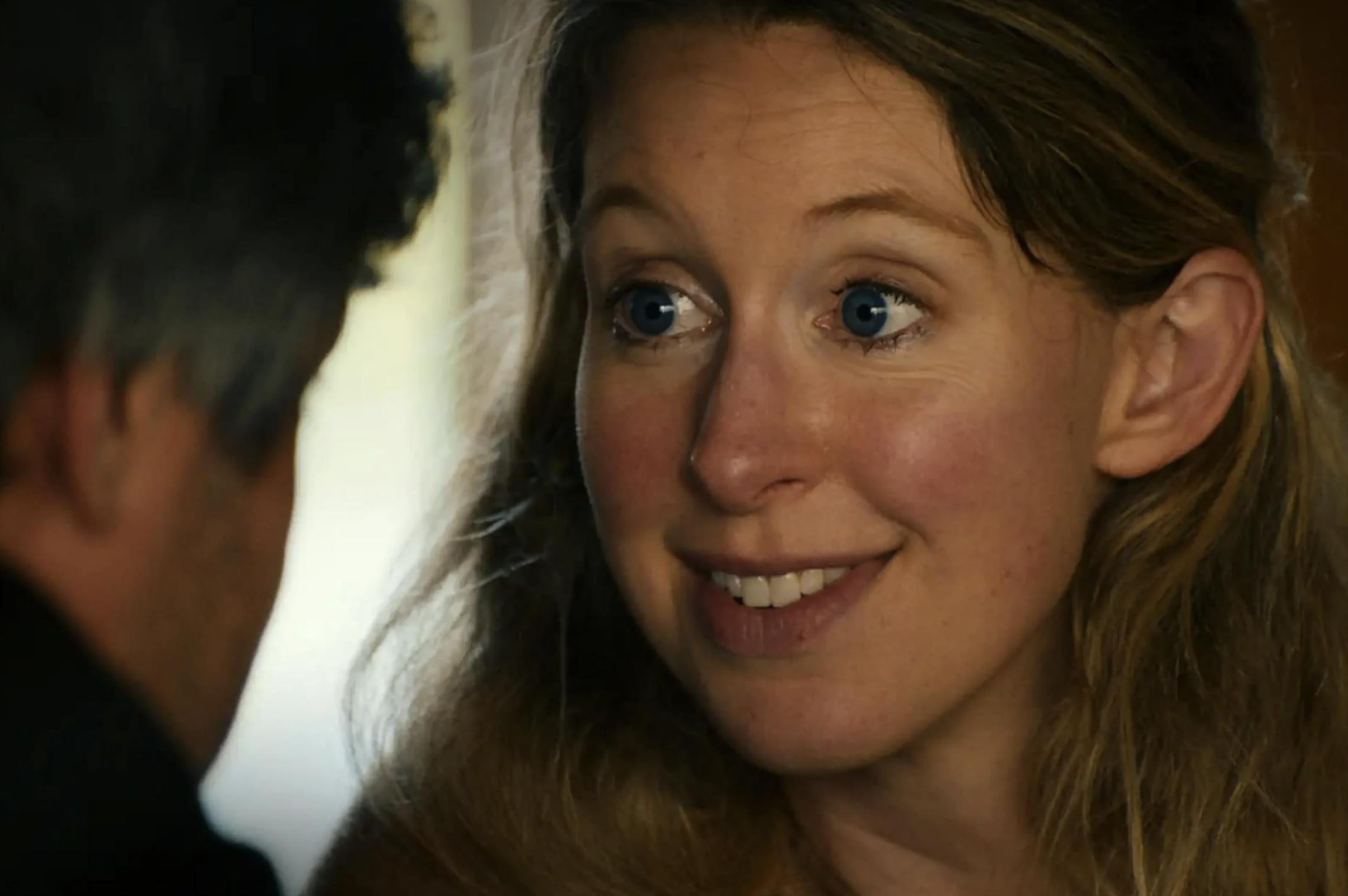
“You Can See Everything” is easily one of the year’s best films that will take viewers on a journey that will entertain, confound, enrage, and more. Directors Nathan Fielder and Lance Oppenheim take what could be a basic—but still pointedly interesting—character study of an infamous figure at a specific time in their life and expand it to include broader questions about reality and morality in a way that still engages with main subjects but also interrogates the very zeitgeist of the moment. It’s a fascinating portrayal of lies and trust, the ways in which people manipulate others through their words, and the ways in which audiences are manipulated through filmmaking itself. It’s twisty and packs a punch but never feels overwrought or overthought, instead remaining relatable even as it ventures through truly bizarre territory.
34 days before she must turn herself in to prison for committing investor fraud, Elizabeth Holmes is spending time with her boyfriend, Billy Evans, and their two children…also a documentary crew headed by Nathan Fielder. Holmes and Evans wanted people to get to know her beyond the headlines and accusations and time is running out before her prison sentence. What Fielder finds is a unique relationship made up of two individuals, both of whom will test his perception of honesty and control.
A lot more happens in “You Can See Everything” than the synopsis posted above — including the filming going beyond Holmes’ surrender date and the role that Evans is playing in their new financial venture, amongst other things. But part of the power of “You Can See Everything” is in its unfolding in new and unexpected directions that defy the usual documentary set-up. Its questioning and twisting of reality is more akin to Fielder’s work on “The Rehearsal” than it is to “The Inventor: Out for Blood in Silicon Valley” (Alex Gibney’s 2019 doc on Holmes). As such, there are some elements that are best withheld to avoid lessening their impact but suffice to say that “You Can See Everything” is a wild ride that will linger in your mind for a long time.
Like Welles’ “F For Fake,” audiences are treated to constantly having the rug pulled out from underneath them through the developments of the story and through the filmmaking techniques of Fielder and Oppenheim. There are lots of aspects of Holmes and Evans (and their relationship) that will infuriate viewers, some that will mystify them, and more that will leave them pondering where the truth lies. Fielder and Oppenheim match this ambiguity with an energy that playfully tackles the subject matter but never diminishes it in any way. Instead, what arises is a profile in a very distinct type of person who is currently empowered in our culture—a grotesque egotism and greed that seems incapable of empathy or honesty yet constantly weaponizes both for self-serving purposes.
While wildly different subject matters, “You Can See Everything” also recalls the experience of seeing “Mr. Death,” “Capturing the Friedmans,” “Dear Zachary,” or “Tickled.” Those are all documentaries with surprising routes that appear as the story unfolds. Again, totally different on tonal/emotional levels, but similar in engaging and surprising audiences with the narrative paths that sprout up along the way. Here though, it’s less a natural development of new situations and more a deeper dive into the world that Holmes and Evans create together, always wondering wherein the truth lies. Despite many days together and alleged unfiltered access, do Fielder and company actually know the people at the heart of their film? Can they ever? Who is in control of the narrative and to what end? These are the questions that are probed throughout while wrestling with the reality of situations conceived of by people who may be master manipulators (or are they just differently-brained?).
Fielder and Oppenheim have crafted something that feels timeless but very much of the moment; something eternally human in the quest for knowing another, but also specific to the America that exists in 2026; something that is about communication and trust and human behavior, but can really only spring forth in the environment that Holmes and Evans have created. “You Can See Everything” is a brilliant pairing of the macro- and microcosm, one that is very distinctly about one particular couple and yet ends up expanding outward to be about all our relationships with each other. It’s a film that is at once familiar but totally surprising in a way that only the best con films can be, where even objective reality is in the eye of the beholder, leaving viewers with questions yet excited to never know the whole truth.
4.5 / 5 Stars
Directed by: Nathan Fielder and Lance Oppenheim
Starring: Elizabeth Holmes, Billy Evans, Nathan Fielder
