Vorarephobia is “the intense psychological anxiety or fear of being devoured, swallowed whole, or eaten alive by an animal, monster, or person.” I didn’t realize I may have that phobia until 2022’s “Nope” in which I was terrified and transfixed by the scene in which Jean Jacket swallows and begins to digest a whole crowd of people. “Whalefall” is many things—a survival thriller, a stirring drama, a tale of toxic masculinity and frayed relationships—but it is also a whole lot of seeing a guy get slowly devoured by a giant animal. That’s not reducing director Brian Duffield’s film, it’s a testament that what is a fairly simple (albeit nightmarish) pitch can contain so many multitudes and genuine emotions.
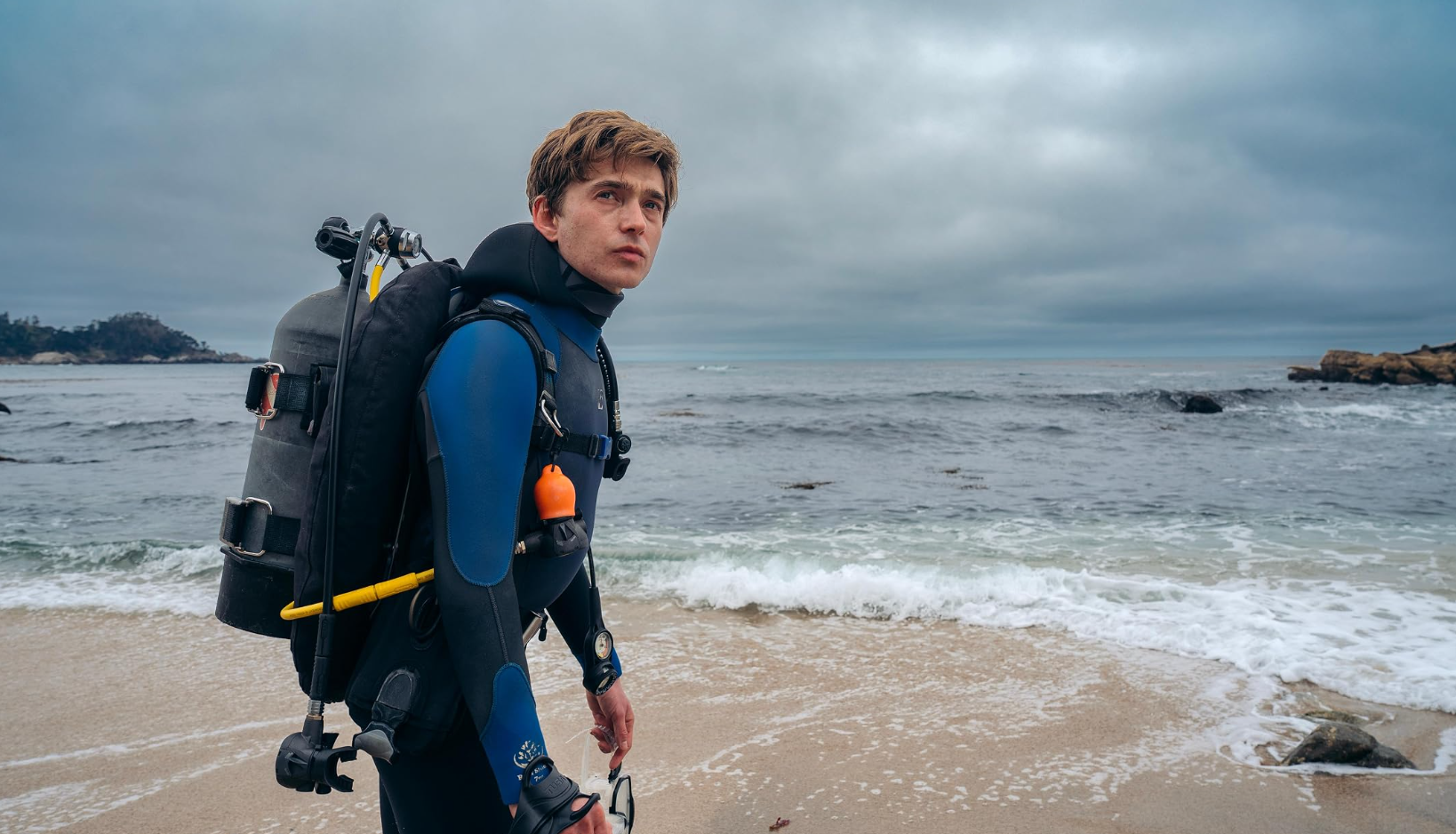
It’s been over a year since Mitt Gardiner (Josh Brolin) died, killing himself at sea rather than face a protracted (and losing) battle against cancer. His son, Jay (Austin Abrams), returns home from Iowa to mark the anniversary—but also has a secret mission: to find his father’s remains at the bottom of the ocean. He straps on his scuba gear and heads out without the rest of his family knowing his plans. Unfortunately, while searching for his father’s bones, he gets swallowed up by a whale. With only an hour of oxygen left and very limited options, Jay must figure out how to escape the creature while his mind flits back to his relationship with his father.
“Whalefall” is an incredibly engaging and moving film that feels both impossible and yet utterly grounded. Part of that impossibility extends beyond just the scenario and the various coincidences that line up to deliver Jay into the belly of the beast. But there’s also a happenstance element to what Jay remembers when that just happens to be exactly what he needs in order to try his next bid for survival. Smartly, the film (co-written by director Duffield and Daniel Kraus, from the novel by Kraus) provides reasons for these fortuitous memories and circumstances, albeit ones that may not satisfy the most critical of viewers. However, even with the grandiose adventure that runs through “Whalefall,” what makes it work best is the truly believable world that is created. I don’t mean the interior of the whale through practical sets and CG—though that does help—but the emotional realm that it inhabits.
Abrams has proven ridiculously adept at being a sympathetic everyman stuck in impossible situations in “Resident Evil” and “Weapons” and he continues that streak with ”Whalefall.” His desperation, anger, and grief is palpable without feeling like histrionics or over the top. He’s a regular guy having the literal worst day ever. But what really sells his panic and pain are the flashbacks between Jay and Mitt, where we see the duo squabble and clash in hurtful and awkward ways that could all be easily solved if they knew how to communicate. Instead, a gulf opens between them where resentment, guilt, and distrust flourishes. Brolin is integral to these scenes as well — playing the diligent dick of a father who wants the best for his children but can’t get out of his own way. The anguish feels as crushing as the gullet of the whale, a not subtle metaphor that Duffield and company still manage to land with poetic expertise.
“Whalefall” also impresses through excellent staging and camerawork, thanks to Duffield and Director of Photography Aaron Morton. The interior of the whale is often pure chaos, yet audiences aren’t struggling to understand what’s going on. There’s no blurry handheld craziness, or other attempts at conveying the pandemonium, but instead relying on the set and the actor to properly set the tone and the camera catches it all. It’s often tumultuous bedlam, and feels that way, but not at the risk of losing focus on what’s happening or confusing viewers as to what’s going on for Jay or the whale.
The supporting cast (Elisabeth Shue as Jay’s mother, Emily Rudd and Jane Levy as Jay’s sisters, and John Ortiz as Mitt’s friend) don’t have as much to do, but still help contribute to the film. “Whalefall” really is focused on the two duos—Jay and his father, Jay and the whale—but Duffield still creates a sense of the world around them that helps bolster the emotional arcs in the storytelling. This is also achieved with help from an excellent score by Joseph Trapanese, which beautifully mirrors the frantic insanity and the quieter torment as the scene requires.
Yes, “Whalefall” is one of those “the subtext is so loud it’s basically just text” movies where the central metaphor of crushing guilt and generational divides becomes very obvious very quickly. But that doesn’t make it a bad film, as it matches the heightened stakes and emotional volatility of the situation leading to a powerful and cathartic crescendo. With “Whalefall” it’s very much more the journey than the destination, and Duffield and company wisely make that journey an enthralling ordeal narratively, visually, and emotionally to fully engage with the audience. Yes, it’s a terrifying prospect to be swallowed by a whale—but such a harrowing experience can also make for a tremendous tale of love and loss.
4 / 5 Stars
Directed by: Brian Duffield
Starring: Austin Abrams, Josh Brolin, Elisabeth Shue, John Ortiz, Jane Levy, Emily Rudd
