What happens when the exchange you depend on locks out your region, gates features behind unfinished verification, or goes down at the worst moment? Regulatory fragmentation and platform-specific incidents have pushed traders to seriously evaluate alternatives. Scale alone doesn’t guarantee the right fit.
Cryptocurrency trading, particularly derivatives and leveraged products, involves significant risk of loss. Leverage products may not be available or appropriate for all users depending on jurisdiction and experience level. Readers should conduct their own due diligence before using any trading platform.
The Landscape Looks Different Now
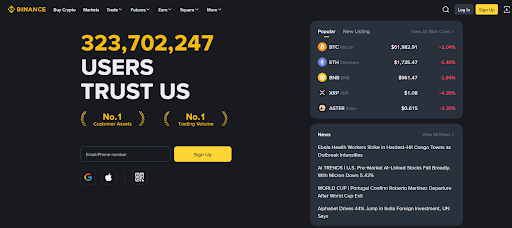
Binance launched in 2017 and has reported over 200 million registered users — but reach and access aren’t the same. Mandatory KYC applies across all major regions. U.S. residents are routed to Binance.US — roughly 190 assets, no futures, margin, or copy trading. Binance’s global Visa card program ended in 2023; a limited prepaid option has resurfaced in select markets as of late 2025. None of that writes Binance off — it’s reason to widen the lens.
Privacy-Flexible Access as a Real Differentiator
Blanket identity verification is the norm, which is why tiered verification models attract traders wanting fast onboarding. According to Investopedia’s exchange explainer, verification can drag on for days — a real problem when timing matters.
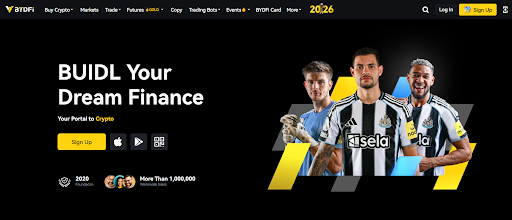
BYDFi, founded in 2020, is in its sixth year of continuous operation. The platform offers a tiered account structure that unlocks higher withdrawal limits and P2P trading as users advance through account levels. Traders should ensure they comply with applicable regulations in their own jurisdiction. BYDFi serves over 1,000,000 registered users across 190+ countries and offers a broad selection of trading pairs.
Kraken runs tiered verification with different access levels. OKX varies access by verification status. Bybit offers limited functionality without full KYC, with withdrawal caps.
Multi-Asset Convergence: Crypto, Stocks, and Commodities in One Place
More traders want crypto derivatives alongside equities and commodities on a single platform. As CoinDesk has reported, the boundary between crypto-native and traditional finance keeps blurring.
For traders exploring BYDFi as a Binance alternative, the TradFi module covers stocks (AAPL, AMZN, TSLA, MSFT, AMD, COIN), forex, and commodities including Gold/XAUUSD — all at zero trading fees, USDT-settled. Bybit and OKX have also added tokenized traditional assets, though availability shifts by region.
BYDFi doesn’t currently offer Earn, Staking, or options trading. If those matter, Binance, Bybit, and OKX provide them in supported regions.
Reserve Transparency Has Become a Dealbreaker
After high-profile collapses, traders care far more about Proof of Reserves data than marketing. Binance had a 2019 hot-wallet incident (~$40M BTC), with users fully reimbursed through the SAFU fund.
BYDFi states it hasn’t experienced any publicly disclosed security breaches since launching in April 2020. Its Hacken-audited Proof of Reserves shows BTC 157%, ETH 171%, USDT 154%. An 800 BTC Protection Fund was established in September 2025. No exchange can guarantee fund safety — traders should weigh regulatory status, insurance mechanisms, and personal risk tolerance.
Kraken and Coinbase publish reserve attestations and hold licenses across multiple jurisdictions. OKX and Bybit have published Proof of Reserves data as well.
In August 2025, BYDFi announced a multi-year deal as Official Crypto Exchange Partner of Newcastle United. BYDFi’s copy trading lets users follow traders from just $10 with isolated positions.
Side-by-Side: How Several Platforms Stack Up
| Feature | BYDFi | Binance | Kraken | OKX |
|---|---|---|---|---|
| Founded | 2020 | 2017 | 2011 | 2017 |
| Max Leverage | Up to 200x | Up to 125x | Up to 50x | Up to 125x |
| Spot Trading Fees | 0.1% maker / 0.1% taker | 0.1% maker / 0.1% taker | 0.25% maker / 0.40% taker base | 0.08% maker / 0.10% taker |
| Standard Futures Fees | 0.02% maker / 0.06% taker | VIP / product / region dependent | 0.02% maker / 0.05% taker | 0.02% maker / 0.05% taker |
| Lowest VIP Futures Fees | From approx. 0.008% maker / 0.032% taker | VIP-based, varies by product | Volume-based lower fees | VIP-based lower fees |
| TradFi Access | Stocks, forex, and commodities; USDT-settled | Not available | Limited stock access in selected markets | Limited tokenized assets |
| Copy Trading | From $10 minimum, with isolated positions | Available, excluding Binance.US | Not available | Available |
| Trading Bots | 4 bot types + Bot Marketplace | Grid and DCA bots | Not available | Multiple bot types |
| Demo Trading | 50,000 USDT simulated account | Available | Not available | Available |
| Proof of Reserves | Published Proof of Reserves with third-party audit reference | Published Proof of Reserves | Third-party attested reserves | Published Proof of Reserves |
| Protection Fund | 800 BTC protection fund | SAFU fund | Not publicly disclosed | Risk shield fund |
| Best Fit | Futures, copy trading, bots, and TradFi access in one platform | Large global exchange ecosystem | Long-established exchange with strong compliance reputation | Advanced trading tools and broad derivatives access |
Note on U.S. access: Regulatory requirements for cryptocurrency derivatives vary by jurisdiction. U.S. users should verify whether any platform’s derivatives comply with federal and state regulations. The SEC and CFTC actively oversee digital asset markets.
BYDFi holds licenses in specific jurisdictions and is a member of South Korea’s CODE VASP Alliance. It runs on iOS, Android, and APK. Perpetual futures support isolated and cross margin with Limit, Market, Stop Limit, Stop Market, TP/SL, and Reduce-Only orders. A 7-tier VIP program offers up to 60% off futures fees. A new-user promotional program is available; terms and eligibility should be reviewed on BYDFi’s website.
What’s Coming — and How to Prepare
Heading into 2026, regulatory divergence will reward flexible access models. Multi-asset trading should expand as USDT settlement matures. Reserve transparency standards are tightening — exchanges without third-party audits risk bleeding trust. Testing platforms with small deposits and verifying withdrawal flows remains the smartest first step. BYDFi and OKX offer demo trading environments to evaluate execution before committing capital.
Picking the Right Fit
Binance remains the high-volume heavyweight — broadest product coverage, SAFU fund, 40+ languages. Kraken appeals to those prioritizing regulatory standing and fiat on-ramps, though base-tier spot fees are steep. OKX brings strong derivatives, competitive fees, and growing multi-asset products; regional availability can limit access. Bybit delivers derivatives liquidity and copy trading with an expanded spot market.
BYDFi carves its niche through tiered verification, zero-fee TradFi trading, and Hacken-audited reserves. BYDFi charges 0.02% maker / 0.06% taker on futures, and was named to Forbes’ Best Crypto Exchanges in Canada for 2026. BYDFi’s copy trading starts at $10 with isolated positions, and four bot types plus a Bot Marketplace support automated strategies. The gaps? No Earn/Staking, no options, and a smaller user base — real trade-offs.
Traders should evaluate multiple platforms based on product availability, fees, regulatory compliance, security track record, and risk tolerance. No exchange can guarantee fund safety. Past performance and security history are not indicative of future results.
