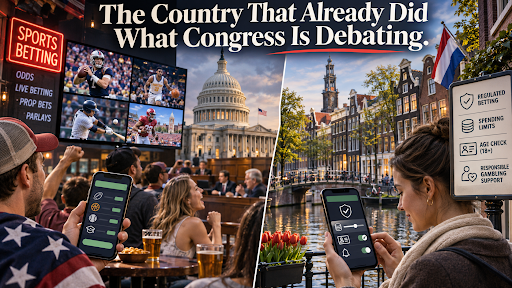
America is considering tougher rules for sports betting. The Netherlands offers a real-world look at what happens when a country puts tighter limits on gambling apps, advertising, and player spending.
Turn on an NFL game on Sunday, and sports betting is never far away. There are pregame odds, live betting markets, promotional offers, and smartphone apps that make placing a wager almost effortless. For millions of Americans, betting has become another part of watching sports. But in Washington, lawmakers are questioning whether the industry has become too good at encouraging people to keep gambling.
The proposed SAFE Bet Act would introduce federal standards for sports betting, including restrictions on advertising, affordability checks, and certain uses of artificial intelligence. Supporters say these protections are overdue. Critics question whether additional restrictions would inconvenience recreational bettors or push some customers toward illegal operators.
There’s an interesting place to look for answers: the Netherlands. The country opened a regulated online gambling market in 2021 and subsequently introduced tighter controls on advertising, player deposits, and gambling-related risks. Five years later, it offers Americans something more useful than competing predictions about regulation: actual experience.
What Congress Wants to Change About Sports Betting
Sports betting expanded rapidly across the United States after the Supreme Court struck down the federal restrictions imposed by the Professional and Amateur Sports Protection Act in 2018. Instead of one national system, individual states developed their own rules for licensing operators, protecting consumers, and controlling advertising. That approach helped build a massive legal industry, but it also created a patchwork of consumer protections.
Representative Paul Tonko of New York and Senator Richard Blumenthal of Connecticut want to establish stronger national standards. Their Supporting Affordability and Fairness with Every Bet Act was originally introduced in September 2024 and reintroduced in March 2025. The current House proposal, H.R. 2087, has not become law. It targets several aspects of the betting experience:
- Financial protection: Affordability checks before operators accept more than $1,000 in wagers within 24 hours or $10,000 within 30 days.
- Deposit restrictions: A prohibition on credit-card deposits and a limit of five deposits per customer within 24 hours.
- Advertising limits: No sportsbook ads on broadcast TV between 8 a.m. and 10 p.m. local time or during live sporting events, and no promotions built around “bonus bets” or “odds boosts.”
- Personalized marketing: Restrictions on using artificial intelligence to create individualized gambling promotions.
- College sports: A prohibition on proposition bets involving individual college and amateur athletes.
Consumer safeguards: A nationwide self-exclusion system for customers who want to stop gambling.
For someone who occasionally bets $20 on an NFL game, some of these changes might have little direct effect. For frequent bettors, however, they could significantly alter how sportsbook apps work — and that’s where the Dutch experience becomes particularly relevant.
The Netherlands Has Already Put Tougher Rules to the Test
The Netherlands opened its regulated online gambling market on October 1, 2021. Licensed companies were allowed to compete under the supervision of the Netherlands Gambling Authority, known locally as the Kansspelautoriteit. Within three years, the government decided that additional safeguards were necessary, and on October 1, 2024, new player-protection measures came into force:
- Monthly deposit limits: New players aged 24 and older faced a default monthly deposit limit of €350. For younger adults, the default was €150. Raising it required personal contact with the operator.
- Financial checks: Operators had to check whether a player could afford it when monthly net deposits exceeded €700 for older adults or €300 for younger adults.
- Session reminders: Every 30 minutes, a pop-up had to remind players how long they had been playing and which limits applied.
- Risk awareness: Operators were required to explain gambling risks when customers requested higher limits.
These figures weren’t absolute spending caps. Players could still request higher limits, but operators had to explain the risks and apply additional safeguards where required. This wasn’t an outright ban on gambling; it was an attempt to slow down decisions that could otherwise happen with a few taps on a phone.
The Netherlands also shows that a legal betting market can keep running under tighter rules. Licensed operators must check every player against Cruks, the national self-exclusion register, and anyone who wants a monthly limit above the default first has to talk to the operator about the risks.
The SAFE Bet Act and Dutch legislation are not identical. They use different thresholds and regulatory structures. But both reflect the same concern: a gambling app shouldn’t be able to encourage unlimited spending without meaningful safeguards.
Sports Betting Didn’t Disappear. The Advertising Changed.
One of the most visible differences between American and Dutch sports betting is the relationship between gambling companies and sports advertising. American fans are used to sportsbook commercials, promotional partnerships, and betting odds woven into game coverage. The Netherlands has taken a much more restrictive approach.
After banning untargeted gambling advertising such as TV and radio commercials in 2023, the country introduced a nationwide ban on sports sponsorship by licensed online gambling operators on July 1, 2025. As the Dutch government explained, online gambling brands could no longer sponsor sports clubs or competitions, which meant removing sportsbook branding from team jerseys and other sponsorship placements. Imagine an NBA or NFL broadcast without the same level of sportsbook promotion surrounding the action — that’s the kind of change American fans might notice if federal advertising restrictions eventually became law.
Yet the logos didn’t disappear so much as change hands. The league’s sponsorship deal with Unibet could only run until July 1, 2025. Since the 2025/26 season, the Dutch top flight has officially been the VriendenLoterij Eredivisie, after a charity lottery bought the naming rights through 2029. Sportsbooks were pushed off the shirts, and a different kind of game of chance got its name on the entire competition. Fittingly, the last company to put its name on the league, from 2002 to 2005, was Holland Casino.
Betting itself carried on. The betting websites in the Netherlands that hold a Kansspelautoriteit license still take bets on the Eredivisie and Europe’s big leagues; they just can’t buy their way onto a jersey anymore. The rules changed how operators attract customers, not whether fans can place a bet. For American policymakers, that raises an important question: can the industry remain competitive without constantly encouraging fans to place another bet?
What Five Years of Dutch Gambling Regulation Actually Tell Us
The most interesting part of the Dutch experiment is that it hasn’t produced a simple success-or-failure story. Figures published by the Kansspelautoriteit on October 29, 2026, show that approximately 94% of people who gamble in the Netherlands did so only with licensed operators during the first half of 2026. That’s a substantial majority.
The financial picture is more complicated. Measured by gross gambling revenue, the regulator estimated that licensed operators captured approximately 59% of the online market during the same period, up from 54% six months earlier. This measure covers the broader online gambling market, including casino games, rather than sports betting alone. The gap between 94% and 59% has a simple reading, and it’s the regulator’s own: people who gamble on illegal sites lose considerably more on average.
Licensed online betting revenue also fell by 30.2% in 2025 compared with 2024. The regulator attributes that decline at least partly to the measures introduced in late 2024, including the net deposit limit. But the comparison year was also inflated, since the 2024 European soccer championship had boosted sports betting revenue.
Another finding deserves attention. In the first half of 2026, the number of accounts at licensed Dutch operators rose to about 1.48 million, up from 1.38 million six months earlier, while the number of people gambling online didn’t grow significantly. The regulator offered two explanations. One was the men’s World Cup, which kicked off in June in stadiums across the United States, Canada, and Mexico. The other was less flattering: some players may be opening accounts with several operators to get around deposit limits that apply per account.
These findings, detailed in the regulator’s 2025–2026 market assessment, show both the potential and the limits of gambling regulation. Protecting bettors and preserving a legal market aren’t necessarily competing goals, but financial safeguards don’t automatically stop people from looking for alternatives. The regulator hasn’t concluded that the 2024 rules pushed players offshore, yet the 59% figure means roughly two of every five euros lost online in the Netherlands still go to unlicensed sites. Regulators need to watch not only spending inside the legal market but also whether customers stay inside it.
And the Dutch aren’t finished. In June 2026, State Secretary for Justice and Security Claudia van Bruggen announced plans for a near-total ban on online gambling ads, an end to bonuses such as free bets, and a minimum age of 21 for the riskiest online games. Those plans still have to pass as legislation.
Could the Same Approach Work in the United States?
The biggest obstacle to applying Dutch-style regulation in America is the structure of the American market. The Netherlands has one national licensing system for regulated online gambling, while the United States relies primarily on state-by-state sports betting regulation. A national law would therefore need to work alongside existing state licensing requirements, enforcement systems, and consumer-protection rules. Several differences make direct comparisons difficult:
- Regulatory structure. Dutch gambling operators work under national licensing rules, while American sportsbooks operate within individual state frameworks.
- Popular sports. European soccer dominates much of the Dutch betting landscape. American betting demand revolves heavily around the NFL, NBA, MLB, and college sports.
- College betting. Restrictions on individual college athletes would have particular significance in the United States, where college sports attract enormous audiences.
- Market enforcement. Both countries face the challenge of preventing illegal gambling websites from attracting customers who want to avoid restrictions.
Enforcement is the part that ties these together. Affordability checks and deposit restrictions only work when operators comply and customers remain within regulated platforms. If legal gambling becomes overly inconvenient, some customers may look elsewhere. At the same time, the Dutch numbers suggest that regulated operators can keep the overwhelming majority of participants under stricter safeguards, even if they don’t keep the same share of the money.
Neither side of the American debate should ignore these findings. Supporters of tougher regulation can point to a functioning market where restrictions coexist with licensed sportsbooks. Opponents can point to the persistent illegal market and the practical difficulty of limits imposed separately by individual operators. Both concerns deserve attention.
The Bigger Question: What Should a Sports Betting App Be Allowed to Do?
The SAFE Bet Act isn’t simply about how much money Americans should be permitted to wager. It’s about the design of the modern sports betting experience. Today’s apps can deliver continuous betting opportunities, personalized promotions, and immediate access to markets during live games. That convenience is part of their appeal, and it’s also what makes regulators worry about excessive gambling.
The Netherlands has spent several years experimenting with ways to preserve legal gambling while limiting some of its risks. Its experience doesn’t prove that every proposed American restriction would work, nor does it show that stronger consumer protections inevitably destroy a legal betting market. What it shows is that the real debate is about where to draw the line between consumer choice and commercial pressure.
Americans have spent years arguing over whether sports betting should be legal. The next debate is harder: once betting is legal, how aggressively should gambling companies be allowed to encourage people to keep playing? The Netherlands doesn’t have a perfect answer. But unlike Congress, it already has years of practical experience trying to find one.
