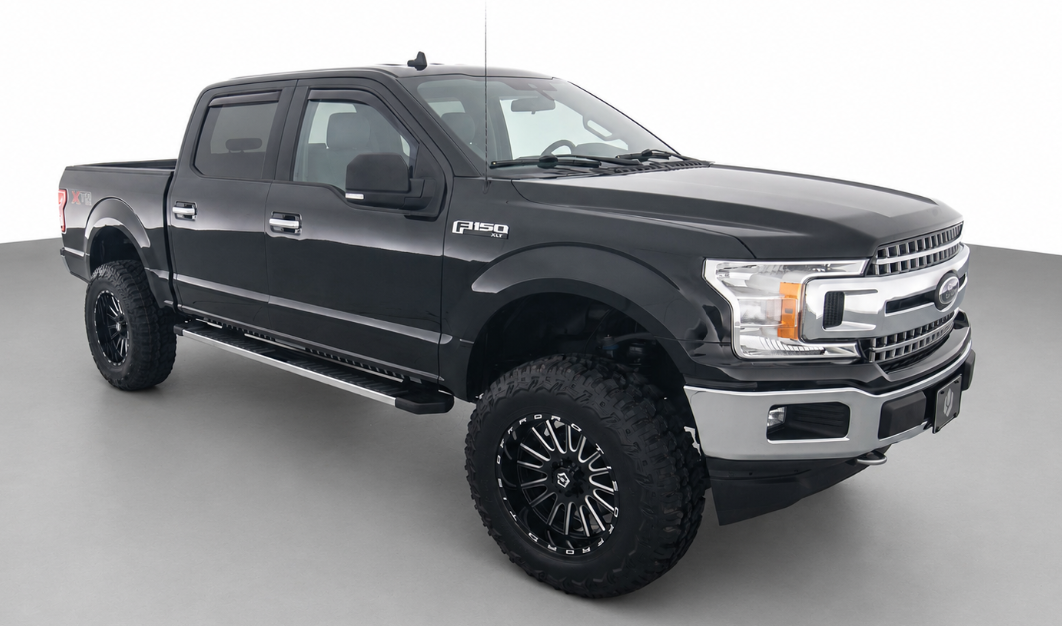
Few truck modifications change an F-150’s appearance as dramatically as a custom lift. A higher stance, larger tires, and more ground clearance can give the truck a stronger presence while expanding its potential beyond smooth pavement. But after the installation is complete, the question most owners eventually ask is not how the truck looks. It is how the truck feels from behind the wheel.
The honest answer is that lifting an F-150 does not automatically make its ride better or worse. Ride quality is shaped by the entire suspension package, including spring rates, shock damping, suspension geometry, wheel and tire weight, tire construction, and inflation pressure. A carefully engineered setup can remain remarkably comfortable, while a poorly matched combination can feel stiff, bouncy, vague, or unsettled. Ford’s own suspension design relies on carefully balanced components and geometry, which helps explain why changing only one part of the system can affect the overall driving experience.
The First Change Is Often in the Way the Truck Absorbs Bumps
One of the most noticeable differences after lifting an F-150 is the way it responds to uneven pavement. The stock suspension is designed to operate within a specific range of travel and with factory-calibrated springs and dampers. Changing ride height can alter where the suspension sits within that range. If the lift reduces available compression or droop travel, the truck may feel sharper over potholes, expansion joints, and sudden road imperfections.
Shock absorbers play an especially important role here. Their job is not simply to make the ride soft or firm. They control how quickly the suspension moves after encountering a bump. When larger, heavier wheels and tires are added without appropriately matched damping, the extra unsprung weight can make the truck feel less controlled. A properly selected suspension package, on the other hand, can help the wheels react to road surfaces without allowing excessive bouncing through the cab.
This is why two lifted trucks with the same amount of height can feel completely different. A basic spacer lift that retains much of the original suspension may preserve much of the factory character, while a more comprehensive system with upgraded dampers and springs can create a distinctly different ride. The amount of lift matters, but the way that lift is achieved often matters more.
Larger Tires Can Have a Bigger Effect Than the Lift Itself
Many drivers blame a lift kit when their truck begins to ride more harshly, but the tires may deserve much of the attention. Custom lifting often creates room for larger tires, and those tires frequently come with heavier casings and different load ratings. A tire designed for demanding off-road use or heavy-duty service may have a stiffer construction than the factory tire, reducing its ability to absorb small imperfections in the road.
Wheel size also matters. A smaller wheel paired with a taller tire sidewall can provide more natural cushioning, while a larger wheel with a shorter sidewall may transmit more road texture into the suspension and cabin. Ford’s suspension analysis of the F-150 has also highlighted the contribution that additional tire sidewall can make to perceived smoothness.
This is an important consideration when planning a custom lifted F150. The visual appeal of a large wheel and aggressive tire is easy to understand, but appearance should not be the only deciding factor. Tire weight, load range, sidewall height, tread design, and pressure all influence what the driver feels on the road. In many cases, choosing a tire that suits the truck’s actual workload can make a greater difference to daily comfort than changing the lift height by an inch or two.
Steering and Handling May Feel Different at Highway Speeds
Lifting an F-150 also changes the driver’s relationship with the road. Raising the body increases the vehicle’s center of gravity, which can make body movement more noticeable during cornering, lane changes, and sudden steering inputs. The truck may lean differently than it did at stock height, particularly if the suspension and tire package were selected primarily for appearance rather than balanced road performance.
Suspension geometry is central to this issue. The front control arms, steering components, ball joints, CV joints, and other parts operate through specific angles. A quality lift system is designed to manage those angles as ride height increases. More complete systems may use brackets, revised components, or other engineering solutions to keep the suspension closer to its intended operating geometry, while simpler approaches can place greater emphasis on the limits of the factory components. Industry installation guidance consistently emphasizes compatible components and correct suspension travel to avoid overextension and unnecessary stress.
An alignment after installation is therefore not a finishing touch; it is part of establishing predictable road behavior. Correct alignment can help restore steering response and tire contact, while poor alignment can contribute to wandering, uneven tire wear, and a feeling that the truck is less settled than before. Ford has also warned that suspension modifications can adversely affect handling characteristics, making careful component selection and professional installation particularly important.
A Better Lift Can Improve Control Without Making the Truck Harsh
There is a common assumption that better off-road capability must come at the expense of on-road comfort. That is not always true. Higher-quality dampers can provide more controlled movement over repeated bumps, dips, and rough surfaces. Instead of allowing the body to continue oscillating after an impact, properly tuned shocks can settle the truck more quickly.
The key is balance. An excessively soft suspension can feel comfortable during the first impact but become floaty afterward. A suspension that is too firm may control body motion well but transmit sharp impacts directly into the cabin. The best setup depends on how the truck is actually used. An F-150 that spends most of its life commuting and carrying passengers may benefit from different damping characteristics than one that regularly travels over washboard roads, carries heavy equipment, or tackles demanding trails.
Real-world owner experiences also support the idea that lift height alone does not determine comfort. Discussions among F-150 owners frequently point to shocks, tire construction, and overall component matching as major influences on ride quality. Some drivers report little change with properly configured suspension lifts, while others find that upgraded dampers improve control compared with their previous setup. Those experiences are not controlled testing, but they reinforce an important practical point: the complete combination matters more than a single modification.
Everyday Driving Can Reveal Changes That a Short Test Drive Misses
The first drive after a lift installation may feel impressive simply because the truck looks and sits differently. The more meaningful evaluation usually comes later. A daily commute reveals how the suspension handles concrete expansion joints. A long highway trip shows whether the truck feels stable and controlled. A fully loaded bed can expose whether the rear suspension still behaves as expected.
Noise can also become more noticeable. Aggressive tires may produce more road hum, while changes in tire weight and tread pattern can affect acceleration and braking feel. Larger tires may also influence gearing and speedometer accuracy unless the truck is properly recalibrated. These factors are not always described as ride quality, but they contribute to the overall impression of how refined the truck feels.
It is also worth remembering that maintenance becomes part of the equation after modification. Suspension components, fasteners, alignment settings, and tire condition should be checked according to the lift manufacturer’s recommendations. A truck that initially rides well can develop undesirable behavior if components wear, loosen, or move out of specification. The goal is not simply to install a lift and assume the work is finished; it is to maintain the entire system as a working package.
The Best Ride Comes From Building Around How the Truck Will Be Used
There is no universal definition of the perfect lifted F-150. Some owners want a plush highway ride. Others prioritize stability while towing. Some need additional clearance for trails, while others simply want enough room for larger tires and a more aggressive stance. Each objective calls for a slightly different combination of components.
The most successful builds begin with honest expectations. Consider how often the truck carries passengers, how much weight it hauls, whether it tows, what type of roads it travels, and how much off-road use it actually receives. Those answers should guide decisions about lift height, shock type, spring setup, wheel diameter, tire size, and tire load rating.
A custom lift should therefore be viewed as a system rather than a collection of individual upgrades. When the suspension, tires, wheels, alignment, and intended use are considered together, it is possible to create a truck that looks more capable without sacrificing the qualities that made the F-150 enjoyable to drive in the first place.
Conclusion
Custom lifting an F-150 changes more than its appearance. Depending on the components chosen, the truck may feel firmer over sharp impacts, more controlled on rough roads, different in corners, or surprisingly close to stock during everyday driving. Larger tires and their construction can be just as influential as the lift itself, while properly matched shocks and well-managed suspension geometry can make a major difference in comfort and stability.
The most empowering approach is to look beyond lift height and build with purpose. A well-planned setup considers how the truck is driven and matches every major component accordingly. When that balance is achieved, a lifted F-150 can deliver the stance and capability an owner wants while still feeling composed, predictable, and enjoyable on the roads where it spends most of its time.