Full disclosure: I’m not the biggest fan of 2009’s “Avatar.” While I appreciated the (literal) worldbuilding and visuals, James Cameron’s film felt trite in its storytelling, characterization, and action, leaving me feeling pretty cold. And yet I loved 2022’s “Avatar: The Way of Water”—a lot of those same issues persisted, but some were improved upon. The spectacle was made grander and the action more engaging, while the family dynamic expanded the emotional bandwidth to be much more moving to viewers. Plus, who doesn’t love a badass whale serving up beatings to corporate colonizers? Heading into the third film, “Avatar: Fire and Ash,” I was pretty mixed but hopeful and I found the film to be…pretty mixed but largely enjoyable. There’s some awkward dialogue, odd narrative choices, and unfortunate elements that persist, but Cameron proves more than capable of crafting characters that linger in the mind, telling a stirring story, and delivering amazing sequences that truly transfix audiences.
The Sullys are still grieving the loss of their son (at the end of “Avatar: The Way of Water”). Jake (Sam Worthington) is fueling his depression into gathering weapons for what he sees as another inevitable confrontation between the Na’vi and Earth’s colonizers, while also feeling resentment towards the son that survived, Lo’ak (Britain Dalton). Neytiri (Zoe Saldana) is angry at the world, and particularly their adopted human son, Spider (Jack Champion). Teenage Kiri (Sigourney Weaver) is still reeling from her seizures and inability to connect to Eywa (the mother spirit of the planet). Yet, despite this disconnect, she’s able to do a wondrous thing and allow Spider to breathe the air of Pandora. This sets off a string of events where Quaritch (Stephen Lang) re-enters the scene, hunting down his biological child (Spider) by teaming up with an extremist sect of the Na’vi, the Ash People led by the deadly and ambitious Varang (Oona Chaplin). The Sullys and their adopted home by the sea try to stay ahead of the forces allayed against them, but it may be more than they can handle.
What helped “Way of Water” overcome the deficiencies of its predecessor was an expansion of scope from Jake to a full family of characters and acknowledgment of the passing of time between the two entries. By incorporating more folks—and the impact of the years on them—it helped distract from what a void Jake Sully is as a protagonist and character. Worthington’s performance is pretty one-note and the dialogue in the script (written by Cameron, Rick Jaffa, and Amanda Silver) doesn’t help him at all, as Jake is a self-righteous angry soldier who still sees everything in terms of tactics and military parameters. This was brought in sharp contrast with his children in “The Way of Water” for an engaging dynamic. But “Fire and Ash” places Jake in the spotlight again to its detriment, as it’s simply not that interesting. The other big push is Spider, who has some genuinely cringey dialogue delivered pretty awfully too. Spider feels like the Poochie of the “Avatar” series, a pandering audience surrogate that is meant to be cool but comes off as lame with stilted phrasing that isn’t as much “in your face” as it is “falls on its face.” Making these two the focus of the story is a bad call made worse by the fact that neither have any real arc that has any emotional weight. There’s narrative change, but the growth has no real resonance given how bland these two are.
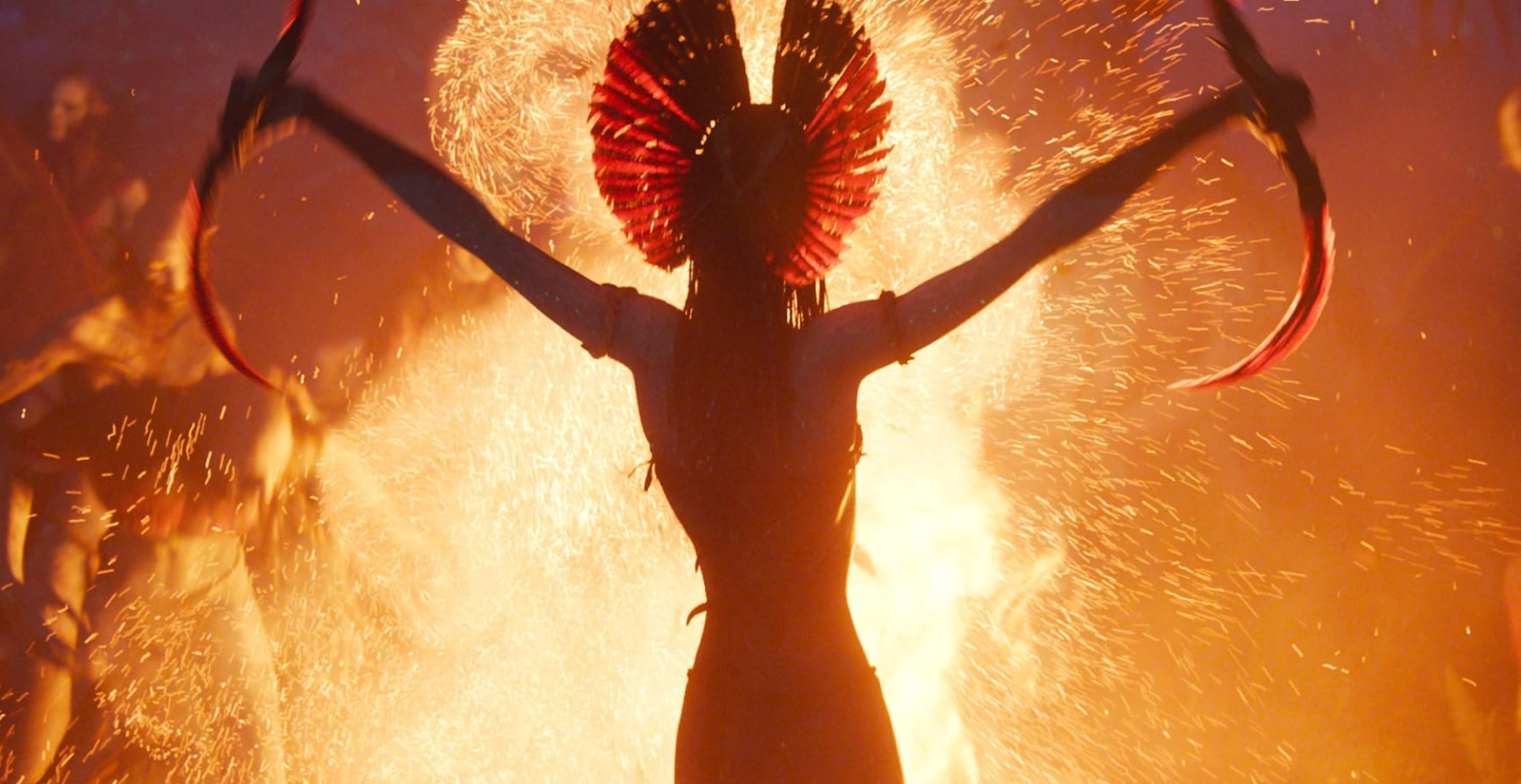
Luckily the 197-minute film isn’t just devoted to those two black holes of charisma. “Avatar: Fire and Ash” has a lot more going on with better characters which helps make the spectacle emotionally engaging. It’s pretty boring to go back to Quaritch as the antagonist on paper, but having the Earth Marine in a Na’vi body “go native” with the Ash People is a strong contrast to Jake’s own journey while also mirroring our own history of the exploitative colonizers who use indigenous people against those they seek to rule (or exterminate). Varang is also a great villainess, with Chaplin bringing a mesmerizing physicality to the part that imbues every moment with a wild energy that feels dangerous in the best of ways. There are also subplots involving Kiri learning to connect with Eywa and Lo’ak partnering back up with Payakan to convince the other Tulkuns that fighting back is the answer to Earth’s seeking of subjugation and genocide of Pandora’s creatures.
All these narrative strands weave together to culminate in a legitimately effective climax. “Avatar: Fire and Ash” stumbles in various places narratively, but Cameron proves he can still compose incredibly stirring action sequences. No matter how chaotic the various fighting gets, audiences are always aware of what is going on, who’s being affected, and what the outcome appears to be. That may sound like damning with faint praise, but there are plenty of directors working with massive budgets that can’t make that same boast, churning out noisy scenes that fall flat without any engagement or clear, distinctive direction. Additionally, “Avatar: Fire and Ash” looks beautiful (though not as great as all the underwater moments in its predecessor) while covering more terrain and locations on Pandora and showcasing incredible F/X in its alien vistas.
“Avatar: Fire and Ash” miscalculates how interesting Jake and Spider are to audiences. And while that poor judgment reverberates throughout the narrative due to lack of satisfaction in these two arcs, the rest of the film remains incredibly solid and entertaining. Cameron and company crafted a compelling universe and situation, pulled from our own world history and writ large on this wholly created world. “Avatar” and “The Way of Water” felt like pastiches of other stories (fictional and real), and “Fire and Ash” is no different, but that provides a richness to the events of the film that fuels some engrossing sequences and establishes some interesting characters. It’s not a flawless victory, but “Avatar: Fire and Ash” is still a mostly good film that improves upon the original and leaves me eagerly anticipating the next installment.
3.5 / 5 Stars
Starring: Sam Worthington, Zoe Saldaña, Sigourney Weaver, Stephen Lang, Oona Chaplin, Jack Champion
Directed by: James Cameron