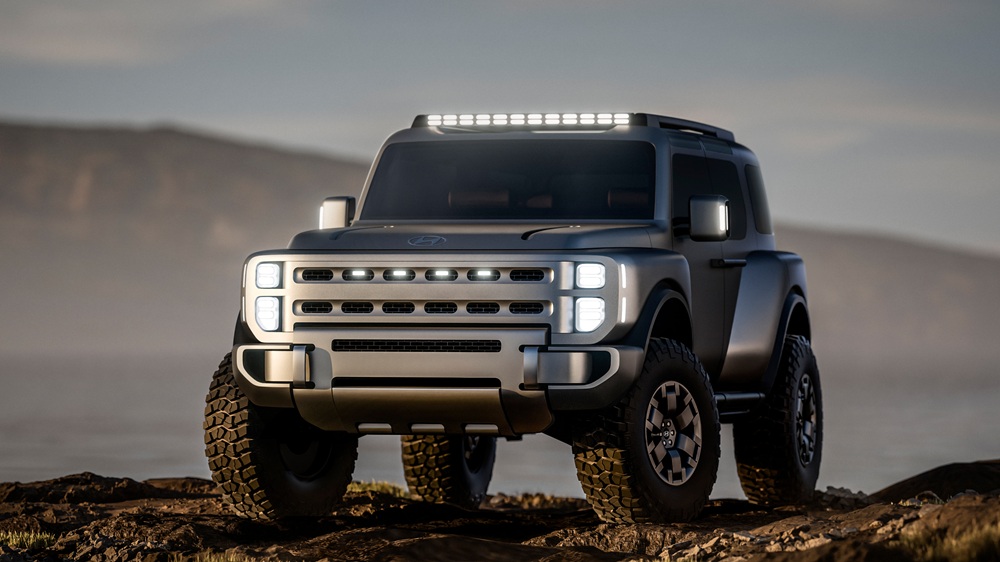
Hyundai just dropped a surprise that’s turning heads at the 2026 New York International Auto Show: the Boulder Concept. This isn’t another sleek crossover or electrified family hauler. It’s a rugged, upright, body-on-frame off-road SUV that feels like a declaration of intent.
I’ve always admired how Hyundai avoided playing it safe with design . . . even if some of them fell flat for me. But this brand takes chances and deserves credit and here we have something more raw and adventurous. The Boulder’s bold proportions, “Art of Steel” design language, and serious trail-ready hardware make it look nothing like a conventional Hyundai—and everything like a serious contender in the world of hardcore off-roaders.
First Impressions: Bold Styling That Breaks the Mold
The Boulder Concept sports a commanding, two-box silhouette with an upright greenhouse, short overhangs, and swollen fenders that give it a purposeful, no-nonsense stance. The design draws from Hyundai’s new “Art of Steel” philosophy, which celebrates the strength, flexibility, and sculptural quality of steel. Think flowing volumes paired with precise, robust lines that emphasize capability over flashy ornamentation. The massive 37-inch mud-terrain tires wrapped around 18-inch wheels jump out, along with the generous ground clearance.
As designer SangYup Lee put it, this is a “four-wheeled love letter to the dynamic, off-road way of life.” It’s designed to feel like it belongs on trails, not just parking lots.
New Body-on-Frame Platform
This isn’t just styling fluff. The Boulder rides on a stout, ladder-frame-style body-on-frame architecture—the kind long favored for real towing, hauling, and trail abuse. Hyundai says it delivers “confident new levels of off-road prowess” alongside genuine utility.
Body-on-frame (also called ladder-frame construction) is a traditional vehicle-building method where the vehicle’s body (the cabin, engine bay, and cargo/passenger areas) is a separate structure that bolts onto a strong, rigid underlying frame — usually a heavy steel “ladder” made of two long rails connected by crossmembers.This frame acts like the vehicle’s backbone. It carries the engine, transmission, suspension, axles, and wheels. The body sits on top of it, somewhat like a house sitting on a foundation.
Body-on-frame has been the go-to for decades for work trucks and hardcore off-roaders because it handles twisting forces on rough terrain without cracking the passenger cell. Unibody is lighter, more efficient, and safer in many crashes (energy absorption is built into the whole structure), which is why it’s dominant in passenger cars and crossover SUVs. Virtually all current Hyundai vehicles sold in the U.S. (and most globally) use unibody construction, so the Boulder breaks the mold.
Can It Compete with Jeep and the Ford Bronco?
That’s the first question that came to mind when I saw the photos of the Boulder. It takes direct aim at the Ford Bronco and Jeep Wrangler segment. It shares that boxy, go-anywhere attitude, massive tires, and modular vibe, but brings Hyundai’s reputation for value, reliability, and modern features into the mix. While the Wrangler and Bronco dominate the serious off-road space today, a production Boulder (or its SUV sibling) could shake things up with competitive pricing, strong warranty, and fresh design.
Hyundai executives have been vocal: they want to give American customers “more of what they want” in the body-on-frame segment, which has long been the backbone of work and adventure vehicles. José Muñoz, President and CEO of Hyundai Motor Company, emphasized competing in the midsize pickup space with everything they have.
Now it’s all about the execution. Let’s see what this concept vehicle is really made of when and if they move to a production mode.
.
