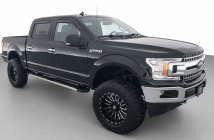
Ford generated quite a bit of buzz when the company unveiled the stunning all-electric Ford F-150 Lightning for the 2022 model year. We were all impressed with the new vehicle, particularly the styling, but we didn’t realize at the time just how much Ford’s EV strategy would be dragged down by this vehicle.
Ford went big into EVs . . . too big. Ford’s early EV lineup leaned toward challenging segments like large and expensive pickup trucks, rather than high-volume, affordable passenger EVs. That fateful decision now sits at the center of one of the most expensive strategic pivots in modern automotive history; one that includes the effective end of the all-electric F-150 Lightning as Ford first envisioned it and a roughly $20 billion charge tied to its EV operations.
It was also part of a larger trend where many companies, not just auto companies, tried to ride the post-Covid wave where consumers had pent up demand and were eager to spend money. Couple that with the inflation surge and companies had the excuse they need to jack up prices. The consumer cooperated for a while, but we all knew that party was going to end.
The Big Swing: Electrifying America’s Favorite Truck
When Ford unveiled the F-150 Lightning, it wasn’t just launching an electric vehicle—it was making a statement. If America’s best-selling truck could go electric, the thinking went, the rest of the market would follow.
But full-size electric trucks are among the hardest vehicles to make profitable. They require enormous batteries to deliver acceptable range, towing, and performance—especially for buyers who actually use trucks like trucks. Those batteries are expensive, heavy, and slow to amortize without huge volumes.
Ford essentially chose the most capital-intensive EV segment first, before battery costs, charging infrastructure, or mainstream consumer demand were ready.
Demand Reality Sets In
Initial Lightning sales were strong among early adopters, but demand softened quickly once Ford tried to move beyond that niche. Prices climbed, incentives became necessary, and inventories began to build.
The broader problem wasn’t unique to Ford. Consumers proved far more cautious about EV adoption than automakers and policymakers expected—especially at higher price points. Can you imagine what EV adoption would have been if Ford and the other automakers had pushed affordable cars in the $20,000 range?
For truck buyers in particular, skepticism about full EV adoption remained high, driven by practical concerns that cut to the heart of how trucks are actually used—most notably the significant real-world range loss when towing heavy loads, the lack of reliable and convenient charging options for job sites, long trips, and rural routes, and the substantially higher upfront costs of electric trucks compared with their gasoline or hybrid counterparts.
What Ford learned the hard way is that truck buyers value reliability, flexibility, and total cost of ownership more than technological symbolism. This should have been obvious.
The Cost Spiral
As demand slowed, the financial consequences mounted quickly. Ford’s EV division was already losing billions of dollars annually, driven by persistently high battery and raw-material costs, insufficient production scale to achieve meaningful cost efficiencies, early EV architectures that proved expensive and inefficient to manufacture, and the heavy burden of factory retooling and long-term supplier commitments made under more optimistic assumptions about EV growth.
When Ford began canceling or restructuring EV programs—including next-generation all-electric large trucks and vans—it triggered massive write-downs. Plants, tooling, battery contracts, and engineering investments suddenly no longer aligned with the new strategy.
That’s how you end up with a nearly $20 billion charge: not from one mistake, but from many big bets made under a single, flawed assumption—that EV adoption would accelerate faster, and at higher price points, than reality allowed.
Where Ford’s EV Strategy Went Wrong
Ford’s core missteps can be summarized simply. First, the company chose the wrong segment to lead its EV push, prioritizing full-size trucks, commercial vehicles, and large, expensive platforms instead of starting with affordable, high-volume EVs such as compact SUVs or sedans. That decision magnified every inherent EV challenge—cost, weight, range, and charging infrastructure—while leaving little margin for error.
Second, Ford overestimated policy-driven demand, building its strategy around the assumption that regulations, incentives, and fuel-economy mandates would pull consumers into EVs; when incentives shifted, interest rates climbed, and political momentum softened, demand fell faster than Ford could adjust.
Third, the company underestimated the appeal of the hybrid middle ground: consumers didn’t reject electrification itself, but rather the all-or-nothing approach, favoring hybrids and range-extended vehicles that offered better affordability, familiar refueling, and meaningful efficiency gains—an insight Ford is now embracing, but later than it should have.
Finally, Ford scaled EV production before establishing a clear path to profitability, attempting to industrialize electric vehicles while still learning how to build them cheaply, unlike competitors such as Tesla that spent years refining cost structures before expanding at scale.
Next Steps
While Ford hasn’t framed it this way publicly, the original vision of the F-150 Lightning as a mass-market, fully electric work truck is effectively over. Future “electric” F-Series trucks are expected to rely instead on hybrids, range-extended EVs, and smaller batteries paired with gasoline engines, reflecting a more pragmatic approach to electrification. This shift is not a retreat from electric technology itself, but a retreat from the ideology that full battery-electric powertrains alone could meet the needs of mainstream truck buyers.
Ford’s reset is notably pragmatic, focusing on leaning harder into hybrids where consumer demand is strong and profit margins are healthier, developing smaller and more affordable EVs later in the decade, slowing capital spending until battery economics meaningfully improve, and rebuilding its EV plans around actual customer behavior rather than optimistic forecasts. In other words, Ford is returning to something it has historically done well: building vehicles people genuinely want to buy.
So it shouldn’t be a surpised that the NY TImes recently did a story on how Ford’s car of the future is being hatched in a skunk works near Los Angeles for release in 2027. The result should be a low-cost EV for the Ford lineup. The question now is whether that’s fast enough!