 It might be a cinephile touchstone from Orson Welles, the most hallowed of all Hollywood mavericks. And, sure, it comes complete with a complex, novel-length making-of story that stretches over four decades. Still, it’s likely that the real reason this odd little thriller refuses to go away is that it was the first important film to combine grimly sensational (borderline-grindhouse) subject matter with A-list movie stars and Class A aesthetics. Even 50 years after studio heads lost patience and dumped it onto the bottom half of double bills, the final Hollywood film from Orson Welles is the opposite of ordinary.
“Touch of Evil” stars Charlton Heston as Ramon Miguel “Mike” Vargas, an Ivy League-educated lawyer and Mexico City official who is wrapping up both the prosecution of a powerful drug lord and his honeymoon with Susan (Janet Leigh), his beautiful and spirited wife from the U.S. For reasons that never become clear, the Vargases happen to be visiting a sleazy Mexican-American border town when a car bomb incinerates a wealthy businessman and his very young date. In short order, Vargas is drawn into the investigation that is being led by Hank Quinlan (Orson Welles), a bigoted and seriously obese local sheriff. He is famous for a large number of convictions and an uncanny ability to collect both evidence (easier to find if you plant it) and confessions (less difficult to obtain with a beating). Meanwhile, the new Mrs. Vargas finds herself in the clutches of some seriously shady characters working for “Uncle” Joe Grandi (Akim Tamiroff) – the brother of the gangster Mike is about to send to prison. In no time at all, it’s a four-way battle for survival as Vargas begins to pursue Sheriff Quinlan for corruption, all the while not sensing that his wife, alone at an isolated motel, is about to be turned into a human bargaining chip in about the most frightening way imaginable.
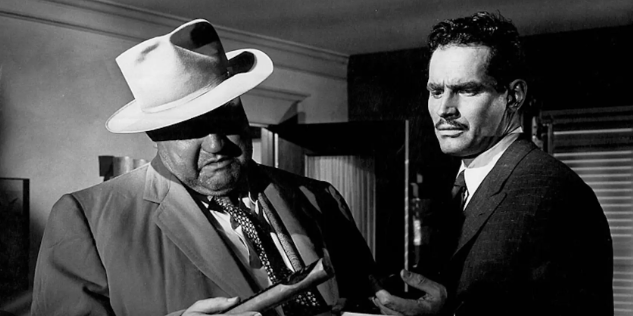 Of course, a mere plot description doesn’t tell you very much about the importance of “Touch of Evil” and its status as one of the earliest cult films. Part of the explanation actually lies in the fact that the film is eternally unfinished. Film buffs sometimes love “lost” classics more than the ones we actually have, and the sizeable cult of Orson Welles has lauded “Evil” for decades as a masterpiece, even in its corrupted state. Moreover, it didn’t hurt that the film’s famed, complex opening — an uninterrupted 3.5-minute tracking shot starting off with a time bomb being placed in a Cadillac convertible and culminating in the obliteration of the vehicle – became legendary in its own right. It was directly homaged/stolen by Brian de Palma (at least twice) and also by Robert Altman, who had Fred Ward’s studio security chief discuss the shot during his own elaborate opening take in 1992’s “The Player.”
Nevertheless, the cinema jury was essentially out until the late ’90s, when producer Rick Schmidlin, genius film editor/sound designer Walter Murch (“Apocalypse Now”), and Welles historian Jonathan Rosenbaum reconstructed the film using a newly discovered 58-page memo from Welles to Universal Studios vice president Edward I. Muhl suggesting a number of alterations. While all involved are careful to emphasize the Schmidlin/Murch/Rosenbaum restoration is no true “director’s cut,” the result was both more obviously innovative and easier to follow than prior versions. On its successful 1998 re-release, the jury came in and it’s now fair to say that “Touch of Evil” is Welles’ most popular, most widely respected, and most complete post-“Citizen Kane” film. Another reputed contender, the Shakespearian “Chimes at Midnight,” is all but impossible to see in the U.S. for legal reasons. Besides, “Touch of Evil” still benefits from a level of perversity that was pretty much unprecedented in anything resembling a mainstream flick in 1958.
I’m not a part of the Welles cult beyond “Citizen Kane” and the first two-thirds “The Magnificent Ambersons” (another epic filmmaking tale). Nevertheless, “Touch of Evil” has really grown on me over the years. And not only because of Russell Metty’s gloriously dank black & white photography, or Welles’ baroque view of material that includes intimations of sadism, masochism, lesbianism, gang rape, and enough heavy duty sexualized stereotyping to start several campus protests. All the while, it’s one of the most progressive films of its time, particularly on racial matters, and with some very relevant thoughts on the abuse of power for the George W. Bush era. To echo the film’s most famous line, Welles was some kind of a director.
Certainly, the finished film is full of outstanding (and often utterly crazed) performances, including Charlton Heston’s work as Vargas, the straight-arrow Mexican prosecutor. While today the performance of the very Anglo Heston would spark mass protests, in the context of the situation it was made in, it was actually a gutsy and progressive move. Originally, Heston’s character was supposed to be American, and the equally Anglo Janet Leigh a Mexican. But writer-director Welles knew that switching the ethnicities would considerably juice up the sexual and not-so-sexual politics of the story. (Interracial marriages were still pretty threatening back then – more so if it was the man who was the nonwhite.) For the most part, the much maligned casting of Heston, a liberal civil rights activist at the time (yes, you read that right), actually works pretty beautifully. Well, with the exception of a couple of unfortunate shots left over from studio-ordered re-shoots, not directed by Welles, in which Heston suddenly looks as if he’s in black (not even brown) face. Though her part is smaller, Janet Leigh’s characteristic mixture of humor, sex and courage add immeasurably to the film. These are evident both in her scenes with Heston and also with the great Russian-American character actor Akim Tamiroff. He plays the Italian-Mexican-American gangster, who manages to be convincing as a ruthless crime boss while also being completely flustered by this outspoken lawyer’s wife who has the guts to call him a “little Caesar.” (One film geek point if you get the reference.)
Orson Welles himself is typically outsized here in more than ways than one, as the post-middle-aged cigar-and-candy-bar-chomping Hank Quinlan. Still only in his early 40s, Welles, known to eat two complete steak dinners or 13 chili dogs at a single sitting, was nevertheless a long way from the morbidly obese Welles of later years. Though most contemporary viewers tend to assume he really looked this way during the shoot, his look was achieved through some outstanding prosthetic facial make-up and copious padding. The result is prophetic, although in some shots his redneck sheriff actually looks a little bit like more like Randy Quaid than the suavely bearded fat Welles of the 1960s and beyond. His performance is one of the best in a career filled with memorable over-the-top performances, a mixture of pure evil and sad loneliness. Also, in typical Welles style, the movie turns out to be more about the power-corrupted Quinlan than the mostly pure Vargas. Welles never stopped being the king of false modesty.
And, since this is a Welles film, the supporting cast is awe-inspiring. Because of the removal of a single shot undermining his character, character actor Joseph Calleia, who plays Quinlan’s deputy and best friend, is revealed as much more than a mere toady and a major contributor to the dramatic success of the film. The previously mentioned Akim Tamiroff is crucial and often hilarious, and so is a young Dennis Weaver, fresh from the set of “Gunsmoke,” playing a megadweeb, borderline insane, motel nightman who could easily be the idiot younger brother of Norman Bates in a sequence that almost certainly influenced “Psycho” just a couple of years later.
Smaller but still crucial roles include Valentin de Vargas (an actual Mexican-American!) as a slickly menacing young thug; uncredited Welles’ pal and good luck charm Joseph Cotton as an affable doctor; Mercedes McCambridge (the voice of Satan in “The Exorcist”) as a malignant leather-jacketed lesbian; a barely present Zsa Zsa Gabor (the producer’s girlfriend at the time, we are told); and, most crucially, Marlene Dietrich. The great German-American siren of the ‘30s and ‘40s was still made for black & white photography in 1958, and she delivers a touching and incisive performance despite playing a disheveled Gypsy madam. Even though her material was shot over a single day, the Dietrich presence, both sardonic and deeply sympathetic, permeates the film. It probably helps that Welles gave her the bulk of the film’s most memorable lines, including the ruthlessly sad rejoinder when Capt. Quinlan asks her to tell his fortune: “Your future is all used up.”
I could go on like this. “Touch of Evil” is not at the level of “Citizen Kane,” but it’s still an extremely hard movie to talk about without writing a dissertation. Politically, it comments on issues like border politics, the abuse of power, and race relations in a bold manner that feels more contemporary than ever. Stylistically, it is nearly as innovative as “Kane.” In particular, Welles’ ideas about sound, unused until the 1998 reconstruction, foreshadow the greater realism in the use of “source” music for films that Walter Murch and George Lucas honestly believed they were inventing with the groundbreaking sound design of “American Graffiti.” It also contains one of the most terrifying murder scenes in any pre-“Psycho” movie.
Still, all you really need to know about “Touch of Evil” in its present form is that it’s an off-kilter but constantly fascinating entertainment that still has the power to disturb and delight. An imperfect film with minor minuses and great pluses, it stays with you. If you’re anything like me, you’ll find yourself thinking about it at odd times – whether you want to or not.
4 / 5 Stars
Starring: Charlton Heston, Janet Leigh, Orson Welles, Akim Tamiroff, Joseph Calleia, Marlene Dietrich, Dennis Weaver, Valentin de Vargas, Ray Collins, Joseph Cotton, Zsa Zsa Gabor
Director: Orson Welles
50th Anniversary Two-Disc DVD Review:
Although a lot of this material has been available before, Universal deserves credit for bringing all of it together with some strong new additions for this 50th anniversary edition. An ideal gift for cinegeeks with lots of free time, the disc includes all three extant cuts of “Touch of Evil.” This makes for five and a quarter hours of compare and contrast fun, which true compulsives can use in conjunction with the famed 58-page production memo, also included (large type on small pages, fortunately). An entertaining featurette-length documentary from the 1998 includes interviews with Charlton Heston and Janet Leigh, as well as superfan restoration producer Rick Schmidlin, director/actor Peter Bogdanovich (never very far from any Welles-related project), critic Jonathan Rosenbaum, George Lucas and others.
And then there are the four commentaries included with all three cuts: A 1998 recording with a star-struck Rick Schmidlin chatting up Heston and Leigh (both now sadly deceased); a cineaste film-crit fest (fun if you’re into that stuff) with Rosenbaum and fellow Wellesian scholar James Naremore; a sometimes florid analytic commentary from Welles-worshipping film critic and screenwriter F.X. Feeney; and, my favorite, a sincere and good-hearted 2008 reminiscence on the film’s reconstruction with Rick Schmidlin. Schmidlin has made more than 20 features, but he considers his work restoring “Touch of Evil” to be the career highlight of his life, and he speaks with sincere affection of the people he worked with on the project. You can’t fake that kind of dedication and love.
