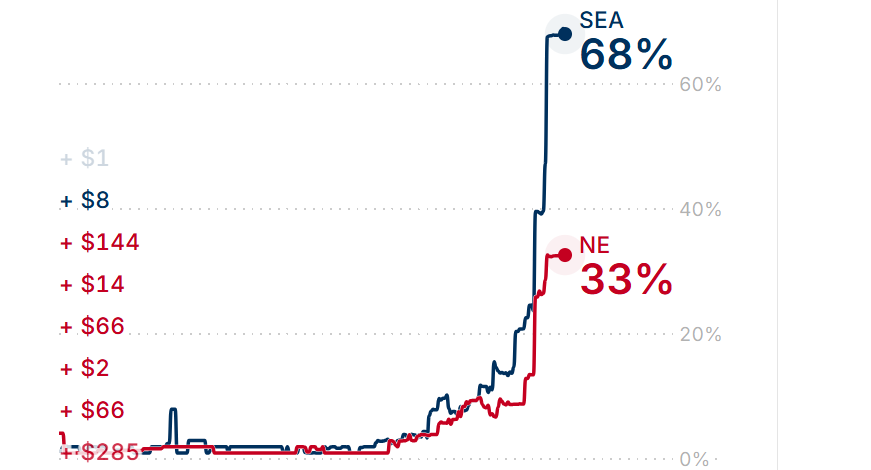
If you go to the Kalshi home page today, you’ll see the graph above, which shows that more people are currently predicting that the Seattle Seahawks will win the Super Bowl over the New England Patriots.
This notable simply because we’re see a shift in the world of sports betting, with prediction markets starting to take business from traditional sport betting apps and sportsbooks. Recently I had a conversation with a large podcaster, who said that the sports betting apps were spending less on advertising as they grapple with the impact of prediction markets.
The Wall Street Journal explores the intensifying competition between traditional sportsbooks like FanDuel and DraftKings and emerging prediction-market platforms Polymarket and Kalshi. The Super Bowl is expected to draw a record $1.5 billion in wagers, and this rivalry highlights a shift in how Americans bet on sports, exploiting regulatory differences to reach underserved markets.
Sports Betting Apps
Traditional sports betting exploded after the 2018 Supreme Court decision that overturned a federal ban, allowing states to legalize it. FanDuel and DraftKings, originally daily fantasy sports platforms, now dominate with about 80% of the market share. FanDuel’s parent, Flutter Entertainment, boasts a $31 billion market cap, while DraftKings stands at $15 billion. Americans placed nearly $151 billion in bets through November 2025 (per the American Gaming Association), generating $15 billion in revenue while surpassing all of 2024’s $13.8 billion. These companies set odds, profit from the “vig” (house edge), and operate under state licenses that enforce age limits (typically 21+), addiction safeguards, and data-sharing for game integrity.
Prediction Markets
Prediction markets, however, operate differently. Regulated federally by the Commodity Futures Trading Commission (CFTC), platforms like Kalshi (founded 2018 by MIT grads) and Polymarket (launched 2020 as a crypto-based exchange) allow peer-to-peer trading on event outcomes such as politics, economy, entertainment, and increasingly sports. Users buy “yes/no” contracts, with prices reflecting crowd-sourced probabilities; the platform earns fees on trades without a house edge. Sports now dominate their volume, making them a de facto alternative for sports wagering.
In prediction markets, betting works differently from traditional sportsbooks. Instead of placing a wager against a bookmaker, you purchase shares—also called contracts—in a binary outcome. These shares represent either “Yes” (the event will happen) or “No” (it will not). The price of each share fluctuates between $0.01 and $0.99, directly reflecting the market’s collective probability of the outcome occurring.
For example, if you invest $100 predicting that the Seattle Seahawks will win the Super Bowl when the “Yes” shares are trading at 68%, or $0.68 per share (see the Kalshi screenshot above), you are buying into the market’s assessment that there is a 68% chance of a Seahawks victory. At that price, your $100 would purchase approximately 147 shares ($100 ÷ $0.68 ≈ 147.06, typically rounded to whole shares or handled fractionally depending on the platform). The total cost to you is $100, plus any small platform trading fee.
If the Seahawks win the Super Bowl and the market resolves in favor of “Yes,” each share you own pays out exactly $1.00. In this scenario, your 147 shares would be worth $147. After subtracting your initial $100 investment, you would realize a profit of about $47, representing roughly a 47% return. The payout comes from the traders who purchased “No” shares (priced around 32¢ each), as they lose their investment when the outcome goes against them.
Conversely, if the Seahawks lose and the market resolves “No,” your “Yes” shares become worthless and settle at $0.00. In that case, you would lose your entire $100 investment (minus any fees). The structure rewards those who correctly identify undervalued probabilities: buying at 68% offers a meaningful but not overwhelming upside if the Seahawks prevail.
Payout timing depends on the platform and the event’s resolution. Once the Super Bowl concludes and the official winner is confirmed—typically through NFL or league sources—the market resolves. Settlement usually occurs quickly, often within hours. Kalshi, for instance, frequently settles markets in about three hours or shortly after the outcome is clear, while Polymarket uses smart contracts for near-instant or very fast automated payouts. Once settled, the funds appear in your account balance, allowing you to withdraw to a bank account (on Kalshi) or a crypto wallet (on Polymarket, often in USDC).
Now this part is really important. You also have the flexibility to sell your shares before the game ends if the market moves in your favor. For instance, if Seahawks momentum pushes the “Yes” price up to 85¢, you could sell early for a profit without waiting for the final outcome. However, if you hold until resolution, the payout follows the structure described above. So if there’s a big lead in the game, or a key injury to the other team before the game, the price will likely go up, and you can lock in profits by selling.
This peer-to-peer trading model distinguishes prediction markets from traditional gambling. Your potential return depends on how accurately the market prices the probability at the time of purchase. In this case, entering at 68% aligns with the Seahawks’ favored status and offers a balanced risk-reward profile. Note that exact share counts, fees, and minor details vary by platform, so always review the specific rules of the site you use. Prediction markets operate under different regulations—Kalshi through federal CFTC oversight and Polymarket often via crypto infrastructure—and availability differs across U.S. states.
State Gambling Laws
Prediction markets have a key edge as they can bypass state gambling laws, enabling access in the 11+ states (including California and Texas) where sports betting remains illegal. This loophole has fueled rapid growth, drawing users nationwide and challenging the incumbents’ geographic limits. FanDuel CEO Amy Howe emphasizes pushing for broader state legalization while using prediction markets to reach more Americans. Both FanDuel and DraftKings launched their own prediction-market products in late 2025, including in restricted states, to compete.
Opposition is fierce. State regulators, attorneys general, and the American Gaming Association argue prediction markets skirt gambling laws, lacking proper licensing, age controls, fraud monitoring, and addiction protections. The AGA, with former New Jersey Gov. Chris Christie as an adviser, calls them disguised bets. Traditional sportsbooks share data with leagues and regulators; prediction markets often do not, raising integrity concerns. The NFL has voiced particular alarm, with EVP Jeff Miller testifying that guardrails absent in prediction markets threaten competition. NCAA President Charlie Baker urged the CFTC to suspend college-sports markets until safeguards exist. Leagues worry about scandals amid recent gambling probes involving players and coaches.
Who Will Win?
The WSJ article portrays this as a bitter turf war: incumbents defend regulated turf and revenue, while prediction markets leverage federal preemption for nationwide reach and innovation. With sports betting projected to keep growing, legal battles will shape the future. Billions are at stake, and this will likely go up to the Supreme Court.